
What Is Trade Promotions Analysis? A CPG Primer
Trade promotions analysis is the discipline of measuring whether a price-driven retail promotion (a feature, a TPR, a display, a coupon) actually moved the business, not just sales for that one week. For CPG sales teams new to the practice, this primer covers the vocabulary, the three signals that matter, the data you'll need, how the discipline differs from a standard sales recap, and the pitfalls that most often lead teams to the wrong conclusion.
Trade spend is the single largest discretionary budget in consumer goods, often 15 to 25 percent of gross sales for established brands. Yet evaluation stays superficial. Companies lean on sales spikes as a success metric and miss the question that actually matters: was that lift incremental, profitable, and durable?
In a sample of roughly 1,200 promotions we analyzed across mid-market CPG brands in 2024 and 2025, about 38 percent generated negative incremental profit despite delivering visible in-store lift. The gap between 'the promo lifted sales' and 'the promo earned its trade dollars back' is exactly what trade promotions analysis exists to surface.
Key takeaways
- Trade promotions analysis asks whether a feature, TPR, display, or coupon actually moved the business — not just whether sales rose.
- Three signals matter: incrementality, post-promo behavior, and account/SKU-level detail.
- A sales recap is not analysis — it reports what happened without isolating what was caused.
- You need promoted-vs-baseline POS at the SKU and retailer grain to do it honestly.
What is trade promotions analysis, exactly?
A standard sales recap describes what happened: units sold, dollars rung, share-point delta, how the promotion compared to a prior period. Trade promotions analysis goes a step further. It splits the result into the part that came from the promotion itself (incremental) and the part that would have happened anyway (baseline), then asks whether the incremental part paid back the trade dollars spent.
The difference matters because every promotion ships with two costs that never show up on a recap: the discount handed to shoppers who would have bought at full price anyway, and the post-promo dip when loyalists pull future purchases forward. Both are line items in a trade promotions analysis.
| Sales recap | Trade promotions analysis | |
|---|---|---|
| Question answered | What did sales do? | What did the promotion cause? |
| Time horizon | Promo weeks only | Pre, during, and post (often 8–12 weeks) |
| Baseline | Implicit (prior period) | Modeled (counterfactual) |
| Cost accounting | Trade dollars subtracted from gross | Net of cannibalization and post-promo dip |
| Decision it informs | Did we hit the number? | Should we repeat, change depth, or kill it? |
| Risk if wrong | Quarterly target miss | Compounding margin erosion across cycles |
The three signals that matter
Every credible trade promotions analysis covers three signals. Each answers a different question, and the failure modes of trade spend almost always trace back to ignoring one of them.
1. Incremental lift
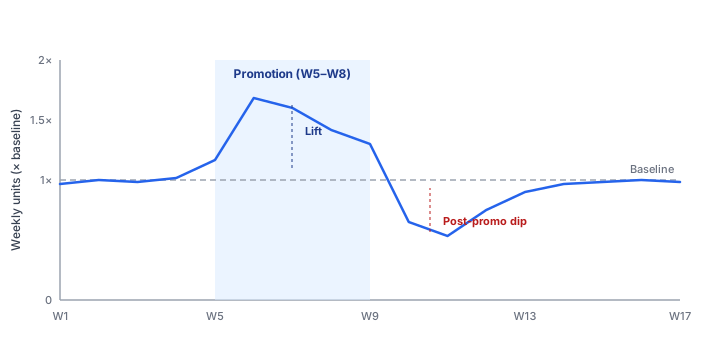
Knowing a promotion's true value means doing counterfactual analysis: working out what baseline sales would have been with no promotional activity at all. That means accounting for seasonality, holidays, competitor moves, and distribution shifts to isolate the genuine incremental gain.
The most common mistake is computing 'lift' as promo-week sales minus the previous year's same week. That treats year-over-year movement as if it were causal, when really the comparison is contaminated by everything else that has changed in the category since.
2. Penetration vs. pantry loading
Panel data tells two outcomes apart: bringing in new household customers, or nudging existing loyalists to shift their purchase timing. The two look identical on the POS sales line and have completely different long-term value.
New-customer acquisition compounds. Once a household tries a product and likes it, the downstream value shows up in repeat purchases. Timing shifts fade fast: the promo just pulls a purchase that would have happened anyway from week 12 into week 6.
You only see this distinction in panel data (Numerator, NielsenIQ Homescan, Circana panel). POS scan data alone cannot tell the two scenarios apart.
3. Baseline reset
The real test comes after the promotion ends. If sales immediately collapse below pre-promo levels, the promo was a temporary subsidy: the brand traded margin for the same volume on a different week. If velocity stays elevated after the promo ends, that points to lasting demand, usually from awareness, new household trial, or distribution gains.
The sustain-lift ratio, post-promo baseline divided by pre-promo baseline, is the cleanest single signal of durability. Above 1.0 means the promotion grew the brand. Below 1.0, it borrowed from the future. The effectiveness playbook walks through a worked example with concrete numbers.
What you need to do the analysis
Three data inputs cover most evaluations:
- POS / scan data: syndicated through SPINS, NielsenIQ, or Circana, or pulled straight from retailer portals (Walmart Retail Link, Target POL, Kroger Stratum, the Whole Foods vendor portal, Costco IRMA). Tells you what shoppers actually bought, at what price, week by week.
- Panel data: Numerator, NielsenIQ Homescan, Circana panel. Tells you who bought (new vs. existing household, repeat rate, basket interaction).
- Trade calendar: your own internal record of which promotions ran where, with what mechanic, at what depth, for how long. It's the join key between the other two sources, and the place where most analyses break.
The hard part is rarely the math. It's reconciling the three sources to a single source of truth on which promotions ran, when, where, and at what cost. Plenty of brands keep this in a spreadsheet maintained by one person, and that's usually the first thing to fix before you scale the analysis. See Why Spreadsheets Don't Scale for CPG Sales Teams for the broader pattern.
Common pitfalls
Pitfall 1: Confusing lift with incrementality
Lift is the easiest number to compute and the worst to act on alone. A 20 percent lift on a 35 percent discount is rarely net-incremental; most of it is pull-forward and pantry-load. Treat lift as a diagnostic, not a conclusion.
Pitfall 2: Stopping the clock at promo end
If your analysis window ends the day the promotion does, you'll systematically miss the post-promo dip. An 8-week post-window is standard; for highly seasonal categories, match to the prior-year same period instead. The longer window often inverts the conclusion you'd have drawn at week 4.
Pitfall 3: Rolled-up averages hide everything
A promotion that's incremental at Kroger and fully subsidized at Sprouts will look 'okay' in the rolled-up number. The actionable answer means breaking down to retailer, and often to banner (Andronicos and Safeway both roll up to Albertsons but make different pricing calls). Aggregate across banners and you've buried the real answer.
Pitfall 4: Trusting the calendar without auditing execution
The most common gap between forecast and actual is execution. A planned 4-week display becomes a 2-week display because of slotting issues. A planned $1.99 endcap shows as $2.49 because of a price-loading error. Always reconcile planned to executed before computing incrementality.
How it differs from a sales recap
Three implications fall out of all of the above for sales teams:
- Lift is necessary but not sufficient. A 20 percent lift on a 50 percent discount may still lose money.
- Time horizon matters. A 4-week window often misses the post-promo dip; 8 to 12 weeks is more honest.
- Retailer and SKU breakdown is non-negotiable. Rolled-up averages hide the events that are actually working, and the ones quietly losing money.
A trade promotions analysis isn't a different report than a sales recap. It's a tighter set of questions asked against the same data. What was the increment, where did it come from, and did it pay for itself?
What trade promotions analysis is not
Two clarifications worth making before the AI hype takes over. First, trade promotions analysis is not the same thing as marketing mix modeling (MMM). MMM is portfolio-level and asks 'how do my total marketing dollars split across channels?' Trade promotions analysis is event-level and asks 'did this specific promotion at this specific retailer work?' Both are useful; they answer different questions on different time horizons, and brands that conflate them tend to under-invest in the event-level discipline.
Second, it's not a substitute for trade strategy. The analysis tells you whether past events earned their dollars. It does not tell you which retailers, mechanics, or shopper segments deserve more capital next year. That's a portfolio decision informed by the analysis, but separate from it. The trap: treating a 12-month rollup of event ROIs as a strategy. It's a scoreboard, not a plan.
Evolution in the age of AI
Automation now handles most of the mechanical work: baseline decomposition, lift modeling, retailer break-outs. That moves human managers off calculation and onto strategic judgment, resource allocation and portfolio design rather than SKU-level recaps.
The bottleneck is no longer 'can we compute the numbers' but 'can we get the numbers in time to change a decision.' Most teams finish the recap of a Q1 promotion in Q2, by which point the Q2 plan is already approved. Closing that loop is where AI-driven analysis is starting to compound into a real advantage.
Human expertise concentrates on interpretation and retailer strategy as the industry finally optimizes a long-underused investment channel. The strategic reframing, treating trade spend as capital allocation rather than a cost line, is covered in From Cost Center to Profit Driver: Rethinking the Role of Trade Spend.
Frequently asked questions
- What's the difference between lift and incrementality?
- Lift is the gross change in sales during the promo window relative to a comparison period. Incrementality is the portion of that lift that wouldn't have happened without the promotion. The difference is what's baseline: sales that would have occurred anyway from existing demand, pantry pull-forward, or seasonal factors.
- How long does a trade promotions analysis take?
- Once data is reconciled, the mechanics take minutes per promotion with the right tooling. The bottleneck is almost always reconciling POS, panel, and trade calendar data into a single source of truth. Brands without that pipeline often spend 70 to 80 percent of analyst time on data prep alone.
- Do I need panel data to do trade promotions analysis?
- For the lift and ROI questions, no: POS plus a trade calendar is enough. For the penetration question (did we add new households or just pull existing ones forward?), yes: that distinction only shows up in panel data.
- What's a good benchmark for promotion ROI?
- It depends on category and retailer, but a useful starting point: is incremental profit positive after subtracting trade spend and accounting for the post-promo dip? Brands that pass that bar on 60 percent or more of their promotions are above-average; the median is closer to 50 to 55 percent.
- How is trade promotions analysis different from forecasting?
- Trade promotions analysis is retrospective: it measures what a promotion already did. Forecasting is prospective: it predicts what a future promotion will do. The two should feed each other: completed analyses calibrate next year's forecasts, and forecasts set the expectations the next analysis is judged against. See How to Forecast Trade Spend ROI for Promotions.
- Can I do this in Excel?
- For a handful of promotions, yes. At scale (dozens of retailers, hundreds of SKUs, weekly cadence) the spreadsheet workflow breaks down on data reconciliation and audit. See Why Spreadsheets Don't Scale for CPG Sales Teams for the failure pattern.
Once you've decided what to measure, the next step is the playbook for how to measure it. A Guide to Trade Promotions Effectiveness Analysis walks through the five-signal framework, the calculations, and the failure modes in depth.
See this on your own data
Scout gives CPG sales teams the analytics infrastructure they need, without spreadsheets.
Get a 15-min demoGet posts like this in your inbox
Retail data, trade promotion, and category management for CPG teams. Roughly weekly. Unsubscribe any time.