
Trade Spend Effectiveness: Measuring What Works
Carol runs trade marketing for a better-for-you cereal brand doing about $48M in retail sales, and trade spend effectiveness is the question she can't answer cleanly. Her annual trade budget is $7.1M, spread across roughly 40 promotions a year at Kroger, Sprouts, Whole Foods, Target, and a long tail of regional accounts through KeHE and UNFI. Every quarter she walks into a budget review and gets the same question from finance: "Is this working?" And every quarter she answers it the same unsatisfying way, by pulling up the three or four promotions that posted big lift numbers and hoping nobody asks about the other 36. That's not measurement. That's curation. This guide is about grading the whole thing honestly.
Most teams can tell you whether a single promotion lifted units. Far fewer can tell you whether their portfolio of trade spend produced the strategic outcome it was supposed to: distribution that held, baselines that grew, the right SKUs gaining at the right retailers. That portfolio-level question is the one finance is actually asking, and it's the one this post answers. If you're evaluating a single event, the companion piece trade promotions effectiveness analysis covers the five-signal framework for one promotion in depth; here we work one level up, at the dollar and portfolio grain.
Key takeaways
- Effectiveness (did it produce the outcome) is not efficiency (was it cheap).
- Grade the portfolio's distribution of returns, not the average — a few wins hide a losing tail.
- Watch the signals of wasted dollars: low incrementality and deep everyday discounting.
- Turn each event's grade into a repeat, adjust, or kill decision.
Effectiveness is not efficiency
These two words get used interchangeably in trade reviews, and the confusion costs real money. They are different tests, and a promotion can pass one while failing the other.
Effective means the spend produced the strategic outcome you wanted. You ran a feature at Sprouts to defend a slot on the cereal set against a competitor's new launch, and the slot held. You funded a Target endcap to seed trial of a new flavor, and post-promo baseline came in 14% above where it started. The dollars did the job they were sent to do.
Efficient means the spend produced that outcome at low cost: high incremental profit per trade dollar, a strong ROI ratio. A promotion that returns $1.40 of incremental profit per $1.00 of trade spend is efficient. One that returns $0.60 is not.
The trap is treating them as the same axis. A Whole Foods deep discount can be highly efficient on paper (great ROI) while being strategically ineffective, because it pulled volume forward from loyal shoppers who would have bought at full price anyway and taught them to wait for the deal. The reverse happens too: a modest TPR at Kroger can look only break-even on ROI yet be exactly the right spend, because it held a distribution point that would have cost three times as much to win back. Effectiveness asks "did we get the outcome?" Efficiency asks "what did the outcome cost?" You need both readings on every dollar, and a strong number on one axis should never excuse a weak one on the other.
What makes trade spend effective
Effective trade spend is not a matter of spending more or discounting deeper. From the portfolios we've graded with mid-market CPG brands, four conditions show up again and again in the dollars that work, and their absence shows up in the dollars that don't.
- Right mechanic for the category. Cereal is a pantry-stockpile category, so a feature-and-display that drives a multi-unit basket beats a shallow everyday-low-price cut. In a fresh or impulse category the answer flips. Using a TPR where the category rewards display is one of the most common reasons spend underperforms.
- Right retailer. A dollar at a strategic account where you're building a partnership and the category is growing is worth more than the same dollar scattered across non-strategic regional accounts that won't renew the slot regardless. Effective portfolios concentrate spend where it compounds.
- Right depth. There's a band where a promotion clears incremental units without training shoppers to wait. For most center-store better-for-you brands that band is roughly 20-30% off shelf. Below it, nothing moves. Above it, you erode reference price and the post-promo dip swallows the lift.
- Sustained, not borrowed, volume. The single hardest test. Effective spend grows the baseline you return to after the promo ends. Ineffective spend pulls future purchases into the promo window and leaves a hole; the volume was always going to be yours, you just paid a discount to pull it forward.
Notice that three of the four are decisions made before the promotion runs: mechanic, retailer, depth. Effectiveness is mostly designed in, not rescued after the fact. The grading discipline below exists so those design decisions get better each cycle. For the planning side of that loop, trade spend optimization goes deeper on how to allocate the budget before events run.
The signals of trade spend effectiveness
When you read a promotion after the fact, the difference between effective and ineffective spend is legible in a handful of signals. None of them is lift alone. Lift is the headline, and the headline lies more often than any other number in trade analysis.
| Signal | Effective spend looks like | Ineffective spend looks like |
|---|---|---|
| Incremental lift | Volume clearly above baseline, net of cannibalization | Lift mostly stolen from sibling SKUs or other retailers |
| Net ROI | Incremental profit covers trade spend, ideally > 1.0× | Negative once spend, cannibalization, and dip are netted |
| Sustain-lift | Post-promo baseline holds or rises (ratio ≥ 0.95) | Baseline drops below the pre-promo level (ratio < 0.85) |
| Retailer fit | Gain concentrated at strategic, growing accounts | Gain scattered across accounts that will not renew |
| Strategic outcome | Distribution held, trial seeded, or share defended | No durable change once the discount ended |
The signal that flips the most conclusions is sustain-lift. A promotion at Kroger can post a 60% lift on the headline and still be ineffective spend if the eight weeks after the event run 10% below the eight weeks before it. You didn't grow the brand. You rented volume from the future and paid retail-funded interest on the loan. The trade promotions effectiveness piece works a full sustain-lift calculation if you want the arithmetic; the point here is that no single-number recap survives contact with the post-promo window.
One honest caveat before we grade anything. These signals are read from syndicated POS data (SPINS, retailer portals), and that data has real seams. Baseline definitions drift between systems, banner-level promotions get rolled up to the corporate parent and blur together, and a competitor's counter-promotion can depress your post-promo window for reasons that have nothing to do with your spend. None of that makes the grading worthless. It means you grade in ranges, you flag the noisy reads rather than pretending they're precise, and you pull category-level sales over the same window so you can tell a brand-specific dip from a category-wide one.
Grading a portfolio, not an event
Grading one promotion tells you whether that promotion worked. Grading the portfolio tells you whether your trade strategy works, and that is the question that moves budget. The method is mechanical: score every promotion on the same signals, line them up in one table, and read the distribution. You're not looking for the best event. You're looking for the shape of the whole book of spend.
Here is Carol's brand grading a representative slice of its portfolio: six promotions run across the spring, five retailers, $1.18M of trade spend in total. Net ROI is incremental profit divided by trade spend; "sustained?" is the read on whether post-promo baseline held.
| Event | Retailer | Spend | Headline lift | Net ROI | Sustained? | Verdict |
|---|---|---|---|---|---|---|
| Feature + display, 25% off | Kroger | $310K | +58% | 1.35× | Yes, baseline +6% | Effective + efficient |
| Endcap, new-flavor trial | Target | $240K | +41% | 0.85× | Yes, baseline +14% | Effective, not yet efficient |
| TPR, 20% off | Sprouts | $95K | +33% | 1.20× | Flat | Efficient, marginal effect |
| Deep discount, 40% off | Whole Foods | $185K | +72% | 1.10× | No, baseline -9% | Efficient on paper, ineffective |
| TPR, 15% off | Albertsons | $120K | +12% | 0.45× | No, baseline -4% | Neither; kill candidate |
| Scattered TPR, KeHE accounts | Regional / KeHE | $230K | +28% | 0.70× | Flat | Ineffective; wrong accounts |
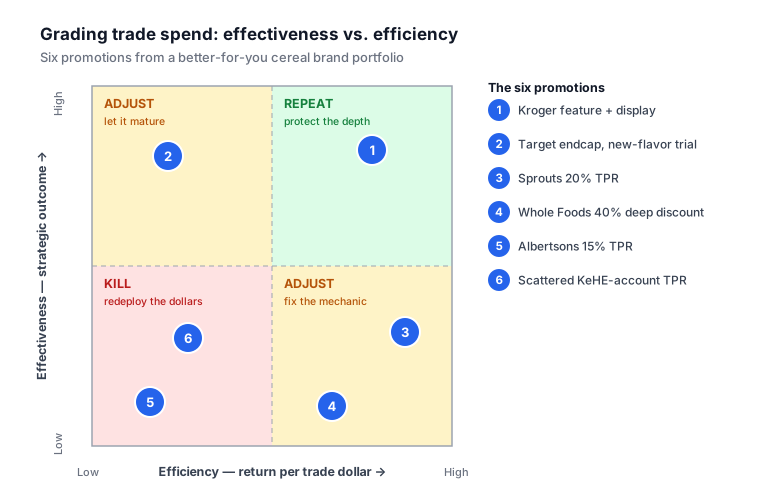
Read across the rows and the portfolio tells a clearer story than any single event could. The Kroger feature is the model: right mechanic for a stockpile category, right depth, profitable, and the baseline actually grew. The Target endcap returns only $0.85 per dollar today, so a recap scoring on ROI alone would flag it red, but its job was trial, and a 14% baseline gain says the trial took. That's effective spend that hasn't turned efficient yet, and killing it would be a mistake. The Whole Foods deep discount is the inverse, and the most dangerous row in the table: a 1.10x ROI that an efficiency-only review would wave through, hiding a 9% baseline erosion. It looks like it worked. It didn't.
The bottom two rows are where the budget leaks. The Albertsons TPR cleared almost no incremental volume and lost money doing it. The scattered KeHE spend was the right idea aimed at the wrong accounts: $230K of trade dollars dispersed across regional accounts that won't anchor a strategic relationship. Together those two rows are $350K, about 30% of this slice, doing close to nothing. That's the number Carol should walk into the budget review with: not "here are our wins," but "30% of this spend is reallocatable, and here's where it should go."
Grade the full book this way, one row per event with the same columns every quarter, and the portfolio scorecard becomes the artifact the budget conversation runs on. For the standing version of this analysis and how to keep it current, see trade spend analysis.
Turning the grade into repeat, adjust, or kill
A scorecard that doesn't change next year's calendar is just a nicer-looking recap. Every graded promotion should resolve into one of three decisions. The rule is deliberately simple so sales, finance, and category can all read the same verdict the same way.
| Decision | When | Example from the portfolio |
|---|---|---|
| Repeat | Effective and efficient: outcome achieved, ROI ≥ 1.0×, baseline held | Kroger feature + display: rebook as-is, protect the depth |
| Adjust | One axis works, the other does not; fixable with depth, mechanic, or account changes | Target endcap (let trial mature, hold depth); Whole Foods (cut depth to 25%, retest sustain) |
| Kill | Neither effective nor efficient: no outcome, negative ROI, and not a defensible strategic bet | Albertsons 15% TPR; scattered KeHE TPR: redeploy the dollars |
Two judgment calls inside the "adjust" bucket are worth naming. The Target endcap is effective but inefficient, so you adjust by giving it another cycle to let the seeded baseline pay back, not by cutting it. The Whole Foods discount is efficient but ineffective, so you adjust the mechanic itself, pulling depth from 40% down to 25% and retesting whether the sustain-lift problem was caused by the discount training shoppers to wait. If a retested promotion still fails its weak axis after one honest adjustment, it graduates to the kill list. Adjust is a one-retry rule, not an indefinite reprieve.
Then comes the part that actually creates value: reallocation. The Albertsons and KeHE kills free up $350K. That money doesn't go back to finance; it goes to the rows that proved they compound. Concentrating it behind another Kroger-style feature window, extending the Target trial program to a second retailer, or funding a new strategic account does more for the brand than spreading it thin ever did. Effective trade spend management is mostly this loop: grade honestly, kill what fails twice, and move the freed dollars toward the mechanics and retailers the scorecard already proved out. Trade spend optimization covers how to model that reallocation before the next calendar locks.
Doing this in Scout
The reason most teams curate instead of grade is that building the scorecard by hand is slow. Pulling SPINS data per event, reconciling baselines across Kroger, Target, Sprouts, and Whole Foods, netting cannibalization, and carrying every read into an eight-week post-promo window is weeks of analyst time, and by the time it's done, the next calendar is already locked.
Scout runs on your SPINS and retail syndicated data and builds the portfolio scorecard automatically: one row per promotion, scored on lift, net ROI, and sustain-lift, with category-level sales pulled over the same window so a brand-specific dip is flagged separately from a category-wide one. The promo-planning tool then carries those grades forward, so the repeat / adjust / kill verdicts and the reallocation become the starting point for next quarter's calendar instead of a recap nobody reads.
We're deliberate about the limits. Scout grades the dollars you can see in syndicated data; it doesn't see your retailer contracts or off-invoice deals, and it flags noisy reads rather than silently correcting them, since a wrong adjustment is worse than a flagged one. What it does do is turn a quarterly curation exercise into a standing, honest grade of every trade dollar.
Summary
- Effectiveness and efficiency are different tests. Effective means the spend produced the strategic outcome; efficient means it did so at low cost. A promotion can pass one and fail the other, so grade both on every dollar.
- Effective trade spend is mostly designed in: right mechanic for the category, right retailer, right depth (roughly 20-30% off for center-store better-for-you brands), and volume that sustains rather than borrows from the future.
- Read effectiveness from five signals (incremental lift, net ROI, sustain-lift, retailer fit, and strategic outcome), never from headline lift alone.
- Grade the whole portfolio, not the best event. One row per promotion, the same columns every quarter; the shape of the book is the answer finance is asking for.
- Resolve every grade into repeat, adjust, or kill (adjust is a one-retry rule), and reallocate the freed dollars toward the mechanics and retailers the scorecard already proved out.
Further reading
- Trade spend analysis: the standing analysis your scorecard runs on, and how to keep it current.
- Trade spend optimization: modeling reallocation before the next calendar locks.
- Trade promotions effectiveness analysis: the five-signal framework for grading a single event in depth.
- Trade Spend: From Cost Center to Profit Driver: reframing the whole budget as capital allocation.
Every trade dollar should be graded, not curated. Reach out at hello@cpgscout.ai if you want to see how CPG brands are putting a portfolio scorecard to work.
Frequently asked questions
- What is the difference between trade spend effectiveness and efficiency?
- Effectiveness asks whether the spend produced the outcome you wanted (incremental margin, distribution, trial). Efficiency asks whether you got there cheaply. A program can be efficient and still ineffective: cheap events that do not move the business.
- How do you grade effectiveness across a whole portfolio?
- Score every event on incremental return, then look at the distribution rather than the average. A few strong events often hide a long tail of break-even or losing ones.
- What do you do with the grade?
- Make a repeat, adjust, or kill call on each event and reallocate the freed dollars to proven winners. See trade spend optimization.
See this on your own data
Scout gives CPG sales teams the analytics infrastructure they need, without spreadsheets.
Get a 15-min demoGet posts like this in your inbox
Retail data, trade promotion, and category management for CPG teams. Roughly weekly. Unsubscribe any time.