
Trade Spend Optimization: More From Every Dollar
A category analyst at a mid-market frozen-food brand opens her trade calendar in January and finds the same problem she found last January. The budget is fully committed, portfolio ROI is flat at roughly 0.9x, and finance has asked for a 1.2x. She can't ask for more money. She can't quietly cut promotions the retailers expect. The only move left is to make the dollars she already has work harder. That is what trade spend optimization actually means, and it's a different exercise than the one most teams run.
Most teams treat "optimize trade spend" as a polite synonym for "spend less." It isn't. Cutting the budget shrinks the program; optimization keeps the program the same size and changes where the money lands. This guide walks through what optimization means, the loop that drives it, the four levers you can pull, where waste tends to hide, and a worked reallocation with real dollar figures. It builds on the trade spend pillar guide, which defines the terms, and it assumes you've already measured your past events. If you haven't, trade spend effectiveness is the prerequisite read.
Key takeaways
- Optimization is reallocating the same budget to higher-return events, not cutting spend.
- Run it as a loop: measure, identify waste, reallocate, re-measure.
- The biggest levers are event mechanics (depth/frequency), account mix, and SKU selection.
- A frozen-food worked example shows ROI can rise with zero new budget.
What trade spend optimization actually means
Optimization is reallocation. You hold the budget constant and shift dollars from low-return uses to high-return uses until the marginal return is roughly equal everywhere. The total spend doesn't move. The blended ROI does.
An example makes the distinction concrete. Say a brand runs $4M in annual trade across 40 events. Twelve of those events return 1.6x. Twelve return roughly break-even at 1.0x. Sixteen lose money at 0.6x. The blended return is just over 1.0x. "Spend less" says: cut the budget to $3M and hope the cuts land on the bad events. Optimization says: keep the $4M, but move the dollars currently funding the 0.6x events toward mechanics and accounts that look like the 1.6x events. Same budget, materially higher blended return, often 1.2-1.3x without a single new dollar.
This matters because trade spend is typically 15-25% of gross sales, the largest discretionary line on a CPG P&L. A 20-point swing in blended ROI on a $4M program is $800K of incremental profit that costs nothing to capture. It is not a budget request. It is a routing decision. The mechanics of measuring each event's return live in trade spend ROI; optimization is what you do with those numbers once you have them.
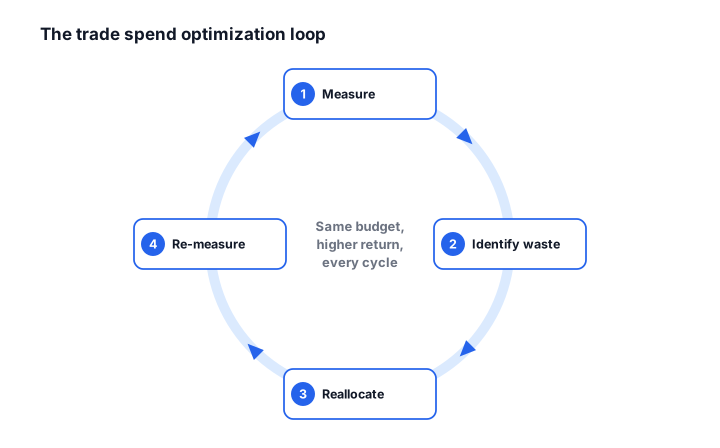
The optimization loop: measure, identify waste, reallocate, re-measure
Optimization is not a one-time project. It is a loop that runs every planning cycle, and each pass should leave the blended return a little higher than the last.
1. Measure
Every event needs an honest incremental ROI: incremental profit divided by trade spend, net of cannibalization and the post-promo dip. Headline lift will not do. A 30% lift at Kroger on a 35%-off TPR can still be a 0.6x event once you subtract the dip. You can't reallocate intelligently against numbers you don't trust, so this step is non-negotiable.
2. Identify waste
Rank every event by ROI and look at the bottom third. Some of those events are genuinely structural, like a Costco pallet drop that builds distribution even at a thin return. Most are not. The bottom third is where the recoverable dollars live, and the next section covers exactly what to look for.
3. Reallocate
Move the dollars freed from the worst events into patterns that resemble your best ones: a better mechanic, a stronger retailer, a tighter SKU set, a better calendar week. Reallocation should be deliberate and bounded. Shift 15-25% of the budget per cycle, not 80%. A program that swings violently every quarter teaches you nothing, because too many variables moved at once.
4. Re-measure
The reallocated dollars become next cycle's events. Measure them the same way, and compare the new blended ROI to the old one. If it went up, the reallocation logic was sound, so push further next cycle. If it didn't, you learned which assumption was wrong. Either way the loop compounds: a brand that runs it cleanly four times a year moves faster than one doing a big annual reset. To run the loop forward instead of backward, pair it with how to forecast trade spend ROI so each reallocation is sized against an expected range, not a guess.
The levers you can pull
Reallocation isn't one move. There are four dimensions you can shift dollars across, plus two depth-and-frequency adjustments inside each event. Most teams only ever use one or two.
Reallocate across retailers
The same promotion rarely returns the same at every account. A natural snack brand we worked with saw a feature-and-display return 1.7x at Sprouts and 0.7x at Safeway, with the same mechanic, the same depth, the same weeks. The shopper bases just respond differently. Moving the marginal dollar from the 0.7x account to the 1.5x-plus account is usually the single highest-impact lever, because retailer response is the widest source of spread in most portfolios.
Reallocate across promo mechanics
A temporary price reduction (TPR), an in-ad feature, a display, and a digital coupon do not deliver the same return per dollar. Deep TPRs are the most common money-loser: they discount every shopper, the loyalists included, who would have paid full price anyway. A feature or display that drives visibility without cutting price as hard often returns more. Shifting dollars from a 25%-off TPR to a feature-plus-shallow-discount is a mechanic reallocation, and it's the heart of the worked example below.
Reallocate across SKUs
Within a line, a few SKUs carry the incremental response and the rest mostly cannibalize. If a frozen brand's promoted 4-count entree gains 12,000 units but its 2-count sibling loses 5,000 in the same weeks, the net incremental story is weaker than the SKU-level recap suggests. Concentrating spend on the genuine traffic-driver SKUs and pulling it off the cannibalizing siblings raises return without touching the budget.
Reallocate across calendar weeks
A promotion that runs against a natural demand peak (frozen comfort food in January, grilling items around Memorial Day at Albertsons) gets a tailwind it never paid for. The same event in a flat week works harder for the same lift. Moving a few events out of dead weeks and into category-demand weeks is a cheap reallocation that most calendars leave on the table.
Adjust depth and frequency
Inside any event, depth and frequency are tunable. The instinct is that deeper is better. It isn't, past a point, and price elasticity is why. Volume responds to discount depth, but not in a straight line. Going from 15% to 25% off might add meaningful units; going from 25% to 35% often adds far fewer units while doubling the per-unit subsidy. Past the elasticity inflection point you're buying volume you'd have gotten anyway and handing margin to loyalists. Frequency has a parallel trap: run the same SKU at the same depth at Kroger every six weeks and shoppers simply stop buying at the shelf price, so your "baseline" is really a discounted baseline, and the promo measures as incremental when it isn't.
Where trade spend optimization finds the waste
Reallocation only works if you know which dollars to move. Four patterns account for most recoverable waste, and each one leaves a fingerprint in the data.
- Unproductive repeat promos. The event that runs every cycle because "the buyer at Kroger expects it," not because it earns its dollars. Easy to spot: a flat 0.7-0.9x ROI, repeated four times a year, never re-examined. A repeat promo isn't automatically bad, but a repeat promo nobody has measured in two years almost always is.
- Over-discounting past the elasticity point. Depth set by habit or by buyer pressure rather than by the elasticity curve. The fingerprint: incremental units barely move between the 25%-off and 35%-off versions of the same event, but trade spend per incremental unit climbs sharply. You're paying for depth the shopper didn't need.
- Spend at non-strategic accounts. Dollars scattered across smaller accounts (a UNFI or KeHE distribution-driven deal, a regional chain) that individually look fine but collectively pull budget away from the Kroger and Sprouts events that actually move the brand. Not every account deserves the same support; spend should concentrate where the brand's strategy says it wins.
- Pantry-loading with no sustain. The event that posts a big in-store lift and then a deep post-promo dip, with the baseline landing right back where it started. The sustain-lift ratio (post-promo baseline over pre-promo baseline) reads well below 1.0. You bought a volume spike and borrowed it straight from the following weeks. The headline looked great; the brand didn't grow.
A practical rule: an event showing two of these four fingerprints is a reallocation candidate, not a tweak candidate. Don't shave 5% off its depth. Move its dollars somewhere else entirely.
A worked reallocation: a frozen-food brand, no new budget
Here is the loop on a real-shaped example. A frozen-food brand runs a $1.2M annual trade program across three retailers: Kroger, Albertsons, and Sprouts. The current plan leans hard on deep TPRs, 25-30% off, run frequently, because that's how the program has always worked. Blended ROI sits at 0.94x. Finance wants 1.20x. The budget stays at $1.2M.
The measure step ranks the events. The deep-TPR events at Kroger and Albertsons are the drag: strong headline lift, but a sustain-lift ratio near 0.90 and heavy loyalist subsidy, so incremental ROI lands at 0.7-0.8x. The feature-and-display events at Sprouts, plus a shallower feature-plus-15%-off mechanic tested at Kroger, return 1.4-1.6x. The waste fingerprints are clear: over-discounting and pantry-loading on the TPRs. The reallocation moves roughly $360K (about 30% of the budget) out of deep TPRs and into the feature-driven mechanic across all three retailers, holding total spend flat.
| Allocation bucket | Before spend | Before ROI | After spend | After ROI |
|---|---|---|---|---|
| Deep TPR, Kroger (25–30% off) | $440K | 0.72x | $250K | 0.86x |
| Deep TPR, Albertsons (25% off) | $400K | 0.70x | $230K | 0.84x |
| Feature + display, Sprouts | $150K | 1.52x | $270K | 1.52x |
| Feature + 15% off, Kroger | $130K | 1.48x | $320K | 1.50x |
| Display-only, Albertsons | $80K | 1.40x | $130K | 1.46x |
| Total program | $1.20M | 0.94x | $1.20M | 1.24x |
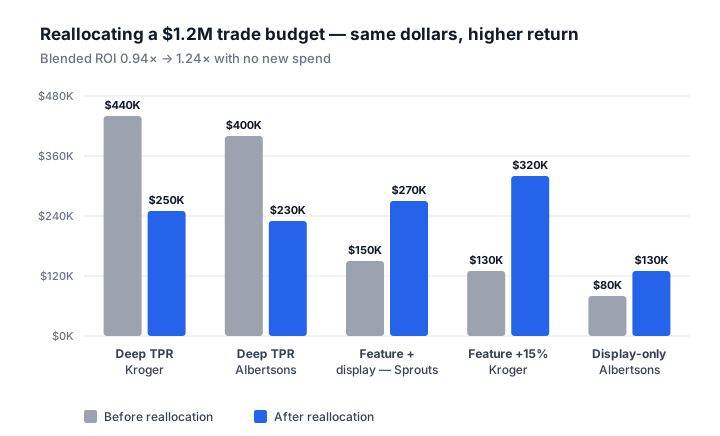
Two details in that table are honest and worth calling out. First, the feature mechanics return slightly less after reallocation (Sprouts feature-and-display drops from 1.58x to 1.49x) because pouring more dollars into a mechanic eventually reaches less-responsive weeks and stores. Marginal return declines as you scale a winner. That's expected, and it's the reason you reallocate 30% rather than 100%. Second, the deep-TPR ROIs tick up slightly even as their budget shrinks, because the dollars that stay are the better-performing weeks; the worst weeks were the ones cut.
The result: blended ROI moves from 0.94x to 1.24x on the same $1.2M. In incremental-profit terms, the program goes from roughly $1.13M of incremental profit to about $1.49M, a gain of $360K, with no new budget and no retailer relationship broken, since every account still has a program. That $360K is the prize, and it was sitting inside the existing budget the whole time.
One caveat: this is one cycle, not a final answer. The next loop re-measures the reallocated events. Maybe the Kroger feature mechanic holds at 1.31x and you push more into it; maybe it softens and you've found its ceiling. The point of the loop is that you find out, then adjust again.
Doing trade spend optimization in Scout
Everything above is doable in a spreadsheet, for a handful of events. The reason most teams don't run the loop cleanly is that the measure step is slow. Reconciling SPINS POS data, retailer portals, and the trade calendar into one trustworthy ROI per event eats most of an analyst's week, and by the time it's done the next plan is locked.
Scout is built to shorten that step. It runs on your syndicated SPINS data, computes incremental ROI and the sustain-lift ratio per event, and ranks the portfolio so the bottom-third reallocation candidates surface without a manual rebuild every cycle. The four waste fingerprints in this guide map directly to checks Scout runs continuously. It doesn't make the reallocation decision for you, that's still a judgment call about retailer strategy and relationships, but it gets you to the decision with weeks of analyst time back and a number you can defend to finance.
If you want to see the loop run on your own program, reach out at hello@cpgscout.ai — or size the opportunity first with the ROI calculator.
Summary
- Optimization is reallocation, not reduction. Hold the budget constant; move dollars from low-return uses to high-return uses until marginal returns roughly equalize.
- Run the loop every cycle: measure honest incremental ROI, identify the bottom-third waste, reallocate 15-25% of the budget, then re-measure.
- Pull four reallocation levers (across retailers, mechanics, SKUs, and calendar weeks) plus depth and frequency tuning inside each event.
- Deeper is not better past the elasticity inflection point; extra depth buys volume you'd have gotten anyway and subsidizes loyalists.
- Waste hides in four places: unproductive repeat promos, over-discounting, spend at non-strategic accounts, and pantry-loading with no sustain.
- In the worked example, reallocating $360K from deep TPRs to a feature mechanic moved blended ROI from 0.94x to 1.24x: $360K of incremental profit on a flat $1.2M budget.
Further reading
- Trade Spend: The Complete Guide: the pillar guide that defines the terms used here.
- Trade Spend ROI: how to compute the per-event return the optimization loop runs on.
- Trade Spend Effectiveness: measuring whether past events actually worked, the prerequisite to reallocating.
- How to Forecast Trade Spend ROI for Promotions: sizing the reallocated events forward instead of guessing.
Frequently asked questions
- Is trade spend optimization the same as cutting the trade budget?
- No. Optimization holds the budget roughly constant and moves dollars from low-return to high-return events. Cutting reduces spend, and usually volume; optimizing improves the return on the spend you keep.
- What is the optimization loop?
- Measure each event's incremental return, identify where dollars underperform, reallocate to higher-return tactics or accounts, then re-measure. It is continuous, not an annual exercise.
- Which levers move the most?
- Event mechanics (discount depth and frequency), account mix, and SKU selection. Reallocating across these usually beats squeezing any single lever. Compare scenarios with the ROI calculator.
See this on your own data
Scout gives CPG sales teams the analytics infrastructure they need, without spreadsheets.
Get a 15-min demoGet posts like this in your inbox
Retail data, trade promotion, and category management for CPG teams. Roughly weekly. Unsubscribe any time.