
CPG Trade Spend: Benchmarks and How It Works
The founder of a 30-SKU better-for-you snack brand sat down to model next year's plan and found a hole she couldn't explain. Gross sales were tracking to $9M. Net sales, the number her investors actually quote, were closer to $7M. The $2M gap wasn't waste, and it wasn't fraud. It was cpg trade spend: the discounts, slotting fees, and promotional allowances she'd agreed to with Kroger, Sprouts, and a regional Albertsons division, line by line, over eighteen months. Every deal looked small on its own. Stacked together, they were the second-largest cost in her business, behind only the cost of the snacks themselves.
That gap is the normal state of affairs in consumer packaged goods, not an anomaly. Trade spend is the single largest discretionary line on most CPG P&Ls, and the least understood relative to its size. This guide explains what it is, why it's so large in CPG specifically, how it flows through the P&L, and what category and channel benchmarks look like, so you can tell whether your number is in line or out of control. For the deeper strategic and operational playbook, the pillar trade spend guide is where to go next.
Key takeaways
- CPG trade spend runs ~15-25% of gross sales because retailers control the shelf and brands fund the promotions.
- It hits the P&L through gross-to-net, turning gross sales into much smaller net sales.
- Benchmarks vary widely by category and channel, so compare within your own.
- It is under growing scrutiny as brands push for ROI accountability on every dollar.
What CPG trade spend is
Trade spend is the money a brand pays retailers and distributors to sell its products, as opposed to consumer marketing, which is money spent reaching shoppers directly. It is not one line item. It's a bundle of distinct deals, and the mix matters because each one behaves differently:
- Off-invoice and scan-down discounts: funding a temporary price reduction (TPR), say dropping a $4.99 cracker to $3.99 at Safeway for four weeks. Usually the largest single bucket.
- Slotting fees: one-time payments to get a SKU onto the shelf. A new flavor entering a Kroger division can run $10,000-$25,000 per item per division.
- Display and feature allowances: paying for an endcap at Sprouts or a spot in the Albertsons weekly ad.
- Everyday or list-price allowances: standing per-case funding to hold a baseline shelf price.
- Distributor and broker fees: the margin paid to KeHE or UNFI to warehouse, sell, and ship a brand into the natural and specialty channel.
The defining feature of trade spend is that most of it is discretionary and negotiated. Unlike the cost of ingredients or freight, it's decided deal by deal, in conversations between a brand's sales team and a retailer's category buyer. That is what makes it both the biggest lever a CPG team controls and the easiest one to lose track of.
It's worth being precise about what is and isn't trade spend, because the boundary moves money around the P&L. A coupon a brand drops in a shopper's app is consumer marketing, not trade: the brand is paying the shopper. A scan-down it funds so Kroger can ring a lower price at the register is trade: the brand is paying the retailer. The distinction matters because the two lines get budgeted, owned, and benchmarked separately. When a brand quietly reclassifies trade as marketing to make a margin number look better, the gross-to-net math still tells the truth a quarter later.
How CPG trade spend works and why it is so large
Trade spend exists in every consumer goods business, but it is uniquely heavy in CPG, and for structural reasons. A snack brand does not sell to shoppers. It sells to Kroger, Albertsons, Costco, Target, and a handful of distributors, and those buyers control the shelf. Access to that shelf, and to promotion on it, is something the retailer can charge for. And does.
Three forces compound to make the number large. The first is retail concentration: a few chains command most of a category's volume, so a brand has limited leverage and pays to play. The second is the promotional cadence of grocery itself: shoppers are trained to buy on deal, and roughly a third or more of CPG units move on some form of promotion, all of it funded by trade. The third is the long tail of fees: slotting, displays, ad features, and distributor margin each look modest in isolation but accumulate fast across dozens of SKUs and a dozen retail partners.
Add it up and trade spend typically lands at 15-25% of gross sales for a CPG brand. For comparison, most brands spend low-single-digit percentages on consumer advertising. Trade is often second only to cost of goods sold (COGS) as a line on the P&L, and it is far more discretionary than COGS, which is exactly why it deserves the scrutiny it rarely gets. The strategic side of that, treating the number as capital to allocate rather than a cost to tolerate, is covered in our guide to trade spend strategy.
How CPG trade spend hits the P&L: gross-to-net
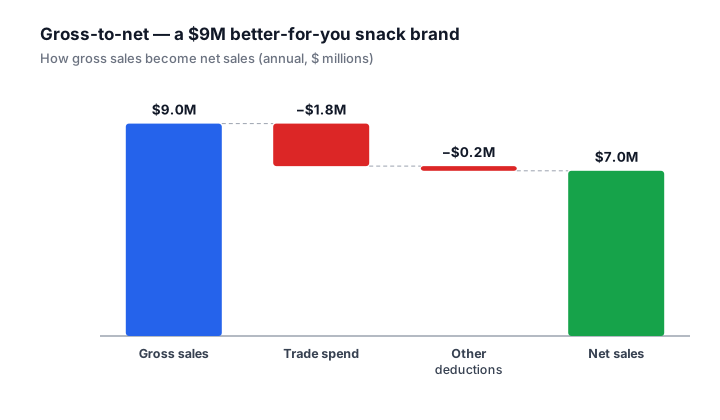
Trade spend almost never appears as a clean expense line. It's a deduction from revenue. The accounting bridge that connects what a brand invoices to what it actually books is called gross-to-net, and trade spend is the largest step in it.
The structure is straightforward:
| P&L line | What it is | Example (annual) |
|---|---|---|
| Gross sales | List price × units shipped, before any deductions | $9,000,000 |
| Less: trade spend | TPRs, scan-downs, slotting, display and feature allowances | −$1,800,000 |
| Less: other deductions | Returns, spoilage, cash discounts, freight allowances | −$200,000 |
| Net sales | The revenue actually recognized: gross sales minus all deductions | $7,000,000 |
| Less: COGS | Cost of the product itself | −$3,500,000 |
| Gross margin | Net sales minus COGS | $3,500,000 |
Two things make this hard in practice. First, trade spend is committed before the sale and settled after it. A brand agrees to fund a Safeway promotion in Q1, the units sell in Q2, and the deduction clears against an invoice in Q3 when Safeway takes the money off what it owes. Tracking a liability across that gap is where most spreadsheet-based systems break down.
Second, because trade spend is a deduction rather than an expense, it's easy to under-manage. It doesn't show up as a check the finance team writes. It shows up as money that quietly never arrived. A brand reporting healthy gross sales growth can be losing net-sales ground if trade spend is growing faster, and the gross number hides it completely. The discipline of reconciling deductions and forecasting the liability is the core of trade spend management.
CPG trade spend benchmarks by category and channel
There is no single right number. Trade spend as a percent of gross sales varies widely by category and by channel, and a healthy figure for one combination is a red flag for another. The ranges below reflect what we see across mid-market CPG brands selling through SPINS-tracked retail; treat them as orientation, not gospel.
By category, the pattern tracks promotional intensity. Center-store grocery staples (crackers, cereal, canned goods) carry the heaviest trade, because the categories are mature, price-competitive, and promotion-driven. Fast-turning impulse categories like salty snacks and beverages also run high. Categories with less promotional habit, or with strong brand pull, run lighter:
| Category | Typical trade spend (% of gross sales) | Why |
|---|---|---|
| Center-store grocery (crackers, cereal, canned) | 20-28% | Mature, crowded, heavily promoted |
| Salty snacks | 16-24% | High velocity, frequent feature and display |
| Beverages (non-alc) | 18-26% | Promotion-trained shoppers, multipack deals |
| Refrigerated and dairy | 12-18% | Shorter shelf life, less deep discounting |
| Premium / better-for-you | 10-18% | Brand pull reduces deal dependence |
By channel, the structure of the deal changes more than the headline percent. The same brand can run very different trade profiles depending on where the volume goes:
| Channel | Example retailers | Trade spend character |
|---|---|---|
| Conventional grocery / mass | Kroger, Albertsons, Safeway, Target | Highest overall; slotting, TPRs, ad features all in play |
| Natural / specialty | Whole Foods, Sprouts, via KeHE and UNFI | Less slotting, but distributor margin is a large embedded cost |
| Club | Costco, Sam's Club | Few promotions, but deep everyday price investment and MVM events |
| Mass with own programs | Walmart, Target | Lower slotting, structured promotional calendars |
A common mistake is comparing a brand's blended trade rate to a single industry number. A premium brand that's 70% natural-channel and 30% club should not benchmark against a center-store grocery average. The useful comparison is category-and-channel specific. Two other factors shift the right number for a given brand. Stage matters: a brand in its first two years on shelf at Sprouts or a Kroger division carries heavy one-time slotting that inflates the rate, and that should normalize as the SKU base stabilizes. Velocity matters too: a slow-turning SKU often needs deeper or more frequent deals to defend its facing, so a brand with a long tail of low-velocity items will run hotter than the category average even when every individual deal is reasonable.
Worked example: an emerging snack brand vs. category benchmarks
Return to the founder from the opening. Her brand is a better-for-you snack, positioned premium but competing on the salty-snack shelf. Gross sales are $9M, trade spend is $1.8M, so her blended rate is 20% of gross sales. Is that good? It depends entirely on where the volume sits. Breaking the $9M down by channel against benchmark:
| Channel | Gross sales | Her trade rate | Benchmark range | Read |
|---|---|---|---|---|
| Conventional grocery (Kroger, Albertsons) | $4,500,000 | 27% | 16-24% | High; over-promoted |
| Natural / specialty (Sprouts, Whole Foods) | $3,000,000 | 14% | 10-18% | In line |
| Club (Costco regional) | $1,500,000 | 11% | 8-14% | In line |
| Blended | $9,000,000 | 20% | n/a | Masked problem |
The blended 20% looks unremarkable. The channel breakdown tells the real story: the conventional-grocery business is running at 27%, well above the 16-24% benchmark for salty snacks in that channel. For a premium brand that should command some brand pull, that is a signal of a deal-dependence problem, likely too many overlapping TPRs at Kroger and Albertsons, propping up velocity the everyday price can't hold. The natural and club channels are healthy. The fix is not to cut trade everywhere; it's to rework the conventional-grocery promotional calendar, where roughly $400,000 of spend is sitting above benchmark. That's the kind of conclusion a blended number will never surface.
Why CPG trade spend is under growing scrutiny
Trade spend has been large for decades, but three trends are pushing it onto more CEO and CFO agendas right now.
Margin pressure. Input-cost inflation across 2022-2025 compressed CPG gross margins, and there are only so many places to find points back. COGS is largely fixed by suppliers and commodity markets; headcount and overhead are slow to move. Trade spend, at 15-25% of gross sales, is the biggest discretionary pool, so it's the first place finance looks when a margin target gets missed. A 2-point improvement on a $9M brand is $180,000 straight to the bottom line, which is often the difference between hitting a board target and missing it.
Private label. Store brands at Kroger, Costco, and Sprouts have improved in quality and gained share. That does two things to trade spend: it intensifies the promotional fight for the branded shopper, and it weakens a brand's negotiating position, since the retailer has a credible in-house alternative on the same shelf.
Retailer media networks. Kroger Precision Marketing, Albertsons Media Collective, and similar programs have given retailers a new, fast-growing revenue stream, and they increasingly steer brand dollars toward retail media and away from, or alongside, traditional trade. For a brand, that means another buyer at the table competing for the same finite budget, and a harder question about which dollar (a TPR or a sponsored-search placement) actually drives incremental sales.
Together these mean trade spend is no longer something a brand can set on autopilot and renew each year. What good looks like has shifted: not the lowest trade rate, but the most deliberate one, with every dollar tied to a measurable incremental return, benchmarked by channel, and reviewed often enough to act on.
Doing this in Scout
Most of the difficulty above is not analytical. It's plumbing. The category and channel benchmarks are knowable. What's hard is keeping a clean, current view of your own trade spend by channel and SKU when the data lives across syndicated SPINS feeds, retailer portals, and deduction records that settle months after the sale.
Scout is built on SPINS and retail syndicated data, so a brand's sales by retailer and channel are already structured. From there it makes the trade picture legible: trade spend as a percent of gross sales, broken out by channel and by SKU, against the kind of benchmark ranges in this guide. The founder in our example would have seen the conventional-grocery 27% the day it crossed the line, not in a year-end model, and she'd have seen which Kroger and Albertsons SKUs were carrying the overage, which is the level a sales team can actually act on.
The same view supports the gross-to-net work. Because Scout already holds sales by retailer, trade spend can be tracked against it as the deductions settle, so the gap between gross and net sales is something a finance lead watches monthly rather than reconstructs at audit time. That shortens the loop between agreeing a deal and understanding what it did.
We're honest about the limits. Scout reports and benchmarks the spend you have; it does not negotiate with Kroger for you, and benchmark ranges are orientation, not a verdict on a specific deal. The judgment of which TPR to cut stays with your sales team. What Scout removes is the months-long lag between a trade decision and the moment you can see what it did to net sales.
Summary
- CPG trade spend (the discounts, slotting, and allowances paid to retailers and distributors) is typically 15-25% of gross sales, the largest discretionary line on the P&L and often second only to COGS.
- It hits the P&L as a deduction, not an expense: gross sales minus trade spend and other deductions equals net sales. That makes it easy to under-manage, because it shows up as money that never arrived.
- Benchmarks vary by category (center-store grocery runs 20-28%, premium 10-18%) and by channel (conventional grocery is heaviest; natural carries distributor margin; club runs lean).
- A blended trade rate hides problems. Break it down by channel against the right benchmark. As the snack-brand example showed, a healthy-looking 20% blended rate concealed a 27% conventional-grocery business.
- Margin pressure, private label, and retailer media networks are all raising scrutiny on trade spend. What good looks like is the most deliberate number, not the lowest.
Further reading
- Trade spend: the pillar guide to how trade spend works end to end.
- Trade spend strategy: treating trade spend as capital to allocate, not a cost to tolerate.
- Trade spend management: reconciling deductions, forecasting the liability, and keeping the number under control.
Frequently asked questions
- Why is CPG trade spend so large, often 15 to 25% of gross sales?
- Because retailers control the shelf and the promotional calendar, and brands fund the discounts, slotting, and merchandising needed to win that space. In many categories it is the second-largest line on the P&L after cost of goods.
- How does trade spend flow through the P&L?
- It sits in gross-to-net: gross sales minus trade spend (and other deductions) equals net sales. That is why unplanned deductions hit reported revenue directly. See trade spend management.
- Where do trade spend benchmarks land by category?
- They vary widely, lower in some center-store categories and higher in heavily promoted ones, so compare within your own category and channel rather than to a single industry average.
See this on your own data
Scout gives CPG sales teams the analytics infrastructure they need, without spreadsheets.
Get a 15-min demoGet posts like this in your inbox
Retail data, trade promotion, and category management for CPG teams. Roughly weekly. Unsubscribe any time.