
Trade Spend Management: A Practical Guide
Dana runs trade marketing at a mid-size beverage brand. It's the third week of the quarter, and she is staring at a $41,000 deduction off a KeHE remittance with a memo line that says, in full, "promo allowance, Q1." She doesn't know which retailer it covers, which event it ties to, or whether sales already accrued for it. The accrual file lives in one spreadsheet, the promo calendar in another, the deduction in the AP system that finance owns. Three teams, three sources of truth, one number nobody can confirm. This is what trade spend management looks like when the lifecycle isn't actually managed.
Trade spend management is the discipline of running that money as a connected lifecycle instead of a string of disconnected handoffs. For most CPG brands, trade spend is 15-25% of gross sales, the single largest discretionary line on the P&L, bigger than marketing and often bigger than the entire G&A budget. And yet it's frequently the least instrumented line on the statement. This guide walks through what the discipline actually involves: the six-stage lifecycle, who owns each stage, the accrual-versus-actual settlement problem that breeds deductions backlogs, and a maturity model for getting from spreadsheet chaos to a closed analytics loop. For the broader strategic context, trade spend is the pillar guide; this post is its operational companion.
Key takeaways
- Trade spend management is the plan-to-settle lifecycle, not just post-event reporting.
- It is cross-functional (sales, finance, RGM); the usual failure is no single owner reconciling planned vs. settled spend.
- The accrual-vs-actual gap is the core problem: estimates and real deductions drift, and the P&L swings.
- Maturity shows up as a shrinking planned/accrued/settled gap and decisions made before events.
What trade spend management is, and why the P&L makes it urgent
Trade spend is the money a brand pays retailers and distributors to drive volume: temporary price reductions, feature and display fees, slotting allowances, scan-down funding, off-invoice discounts. Trade spend management is the operating system around that money. It is the planning, approval, execution, settlement, and measurement that turns a budget into events and events into a verified P&L number.
Why it matters is just arithmetic. On a brand doing $30M in gross sales, a 20% trade rate is $6M going out the door every year. A 3-point improvement in how efficiently that $6M gets deployed is $180,000 of recovered margin, more than most brands' entire trade marketing payroll. The downside is just as big. Unmanaged trade spend leaks through unauthorized deductions, double-funded events, and promotions repeated on autopilot because nobody ever closed the loop on whether the last one worked.
Two failure patterns make the case. First, the budget gets set top-down as a percentage of sales and then spent bottom-up by account, so the total is "managed" but no individual dollar is. Second, the number on the P&L is an accrual estimate that drifts from actual settled spend for months, which means the brand is making margin decisions on a figure that is wrong by design. A real management practice closes both gaps. And before optimizing anything, read trade spend optimization: optimization without a managed lifecycle underneath it just produces faster guesses.
The trade spend management lifecycle
Trade spend moves through six stages. Most brands run all six. The problem is they run them in disconnected tools, so the data never carries cleanly from one stage to the next. The whole discipline comes down to keeping a single event record alive from plan to learning.
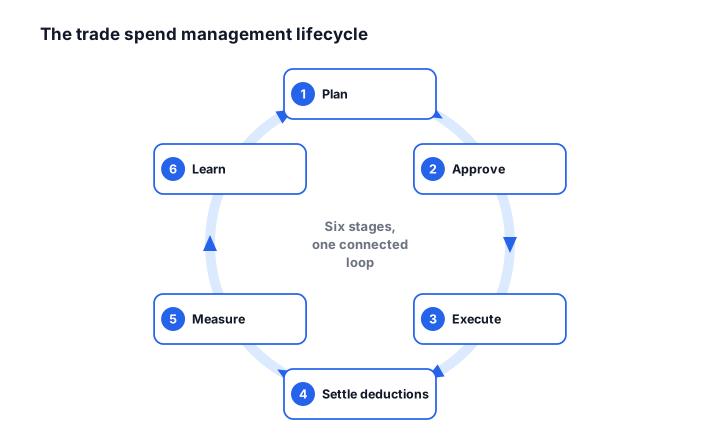
1. Plan
An account manager builds a promotional calendar for each retailer: say, a 4-week TPR on a 12-pack at Kroger in week 18, a display event at Sprouts in week 22. Each line carries an expected depth, an expected volume, and a funded dollar amount. Good planning ties every line to a baseline forecast, so the expected lift is on the record instead of in someone's head.
2. Approve
Trade marketing and finance review the calendar against the budget envelope. The right approval question is not "can we afford it" but "is this the best use of the next dollar." In practice approval is often a rubber stamp, because there's no forecasted ROI to approve against. The team approves the spend, not the return.
3. Execute
The event runs. The retailer drops the price, sets the display, runs the feature. Sales confirms execution, or is supposed to. Compliance gaps start right here: a display that was funded but never built, or a price cut that ran two weeks long. Both create a spend-versus-value mismatch nobody sees until settlement.
4. Settle deductions
The retailer or distributor takes its money, usually as a deduction off an invoice rather than a clean bill. UNFI short-pays a remittance by the promo allowance amount; KeHE does the same on its own cycle. Finance then has to match each deduction to an approved, accrued event. This is where the lifecycle most often breaks, and it gets its own section below.
5. Measure
Once actual spend is settled, the event can be evaluated: incremental lift, incremental profit, ROI, the post-promo dip. This is the step covered in depth by A Guide to Trade Promotions Effectiveness Analysis. The catch is timing. If settlement takes 90 days, measurement lands after the next plan is already locked.
6. Learn
The result feeds the next plan. A repeated TPR at Albertsons that ran a 0.88 sustain-lift ratio twice should get its depth cut or its mechanic changed. "Learn" is the stage that turns the lifecycle into a loop instead of a line. It is also the stage that gets skipped most, because by the time the numbers land, the team has already moved on.
Who owns trade spend management, and where the handoffs break
No single function owns the whole lifecycle, and that is the root cause of most trade spend dysfunction. Four teams touch it, and each one optimizes for a different metric.
- Sales / account managers own Plan and Execute. They are measured on volume and on the retailer relationship, so their incentive is to fund deeper and approve faster.
- Trade marketing owns Approve and Measure. They are measured on trade efficiency, so their incentive is to push back on depth and demand post-event reads.
- Finance owns Settle and the accrual. They are measured on a clean close, so their incentive is to clear deductions fast, sometimes faster than the deductions can actually be validated.
- Revenue growth management (RGM) owns Learn, where it exists at all. RGM is measured on net revenue and margin mix, so its incentive is the long horizon, which is exactly why it tends to be the function starved of timely data.
The breaks happen at the seams. The Plan-to-Approve seam fails when sales submits a calendar with no forecasted ROI, so trade marketing approves a dollar amount blind. The Execute-to-Settle seam fails when sales never logs whether the Whole Foods display actually went up, so finance can't tell an authorized deduction from an invalid one. The Settle-to-Measure seam fails when finance closes a deduction against an accrual without ever tagging it to the event, so the actual cost never reaches the analyst. Every broken seam is a place where a dollar goes unaccounted, and the deductions backlog is what those broken seams pile up into.
The accrual-versus-actual settlement problem
Here is the structural problem at the center of trade spend management: the brand never knows its real trade spend in real time. When an event is planned, sales accrues an estimate, a liability on the books for money the retailer hasn't taken yet. Months later the retailer takes that money as a deduction, and the deduction almost never equals the accrual. The gap between the two is where margin quietly disappears.
Work the example. Our mid-size beverage brand sells through KeHE and UNFI into three retailers (Kroger, Sprouts, and Albertsons) and plans a spring promotional block. Here is the planned, accrued, and actual spend, by lifecycle path:
| Event | Planned spend | Accrued | Actual settled | Variance | Why |
|---|---|---|---|---|---|
| Kroger 4-wk TPR (via UNFI) | $38,000 | $38,000 | $44,200 | +$6,200 | Price ran 2 weeks long; deeper scan-down. |
| Sprouts display (via KeHE) | $22,000 | $22,000 | $0 (so far) | −$22,000 | Deduction not yet taken; accrual still open. |
| Albertsons feature (via UNFI) | $31,000 | $31,000 | $33,500 | +$2,500 | Valid event, allowance rate higher than planned. |
| Unidentified KeHE deduction | $0 | $0 | $41,000 | +$41,000 | No matching event; memo line is blank. |
| Block total | $91,000 | $91,000 | $118,700 | +$27,700 | P&L accrual understated actual by 30%. |
Three things are wrong here, and all three are routine. The Kroger event over-ran its accrual by $6,200 because execution drifted and nobody updated the estimate. The Sprouts event shows zero actual not because it was free, but because the deduction is still in the float: the accrual is right, but the timing makes the P&L look better than reality. And the $41,000 KeHE deduction has no matching event at all. It might be a valid promo the brand simply failed to record, a duplicate of something already settled, or an unauthorized claim the brand is entitled to dispute. Until someone researches it, it just sits in the deductions backlog.
The deductions backlog is the visible symptom of a broken lifecycle. It grows whenever deductions arrive faster than the team can match them to events. Unmatched deductions force a binary choice: write them off (and accept the leak) or dispute them (which takes documentation the brand often doesn't have, because Execute never logged compliance). Invalid or unsubstantiated deductions tend to run roughly 5-10% of gross trade spend for brands without a tight settlement process. On our $6M brand that is $300,000-$600,000 a year, most of it written off because disputing is harder than absorbing. Closing that gap is the highest-ROI fix in trade spend management, and it doesn't require better promotions. It requires a settlement process that ties every deduction back to an approved, executed, accrued event.
A trade spend management maturity model
Brands tend to sit in one of three stages. The point of naming them is to find your stage and the one concrete move that gets you to the next.
Stage 1: Spreadsheet chaos
The calendar, the accrual file, and the deduction log are separate spreadsheets owned by separate people. Events get identified by inconsistent names, so the same Kroger TPR is "KR Q2 12pk" in one file and "Kroger spring" in another. Settlement is reactive: deductions get matched when a controller has a spare afternoon. The accrual on the P&L is a percentage-of-sales estimate, not a sum of real events. Most CPG brands under $50M live here. The diagnostic: if you can't answer "what did we actually spend at Sprouts last quarter" in under a day, you're in Stage 1. The move to Stage 2 is one shared event ledger with a stable event ID that every team uses.
Stage 2: Standardized process
There is one event record, with a stable ID, that carries from plan to settlement. Approvals follow a defined workflow. Deductions get matched against events on a regular cadence, weekly rather than whenever. Accruals are built bottom-up from real planned events, so the P&L number is defensible. What's still missing is the loop: measurement happens, but it's a recap deck that doesn't systematically feed the next plan. The diagnostic: you can reconcile spend, but you can't say which mechanic at which retailer earns the best ROI. The move to Stage 3 is connecting measurement output back to planning input.
Stage 3: Analytics-led closed loop
Every event carries planned, accrued, and actual spend plus a measured ROI, all on one record. Settlement is near-current, so the deductions backlog stays small and disputes get filed with execution evidence. Most importantly, the Learn stage is wired into Plan: a TPR that under-performed twice gets flagged before it's calendared a third time. Trade spend stops being a cost to reconcile and becomes capital to allocate, the shift covered in Trade Spend: From Cost Center to Profit Driver. Few brands are fully here, and getting here is less about software than about the discipline of never breaking the event record.
| Stage | Single event ID | Settlement cadence | Accrual basis | Learn feeds Plan |
|---|---|---|---|---|
| 1: Spreadsheet chaos | No | Ad hoc | % of sales estimate | No |
| 2: Standardized process | Yes | Weekly | Bottom-up from events | Manually, inconsistently |
| 3: Analytics-led closed loop | Yes | Near-current | Bottom-up, ROI-tagged | Yes, systematically |
Doing this in Scout
Scout is built to keep the event record intact across the lifecycle, which is the hard part of trade spend management. The promo-planning tool lets a team build the calendar with a baseline forecast attached to every line, so approval happens against an expected ROI instead of a blank dollar amount. Each event gets a stable ID that carries through to measurement, and because Scout runs on SPINS and retail syndicated data, the measured lift and incremental profit land on the same record as the planned and accrued spend.
What that buys a team like Dana's is a deductions process with something to match against. When a KeHE remittance comes in short, the deduction can be tied back to a specific Kroger or Sprouts event with its accrual and its execution status already on file, turning an unidentified $41,000 line into either a confirmed settlement or a documented dispute. We're honest about the limits: Scout does not replace your AP system or auto-resolve deductions, and the data is only as clean as the event IDs your team maintains. What it does is close the measure-to-learn loop, so an under-performing promotion gets flagged before it's repeated. For a comparison of what to look for in tooling generally, see trade spend management software.
Summary and further reading
- Trade spend is 15-25% of gross sales, the largest discretionary line on a CPG P&L. Managing it as a lifecycle, not a budget total, is where the margin is.
- The lifecycle has six stages: plan, approve, execute, settle deductions, measure, learn. The discipline is keeping one event record alive across all six.
- Four functions own pieces of it (sales, trade marketing, finance, RGM) and handoffs break at the seams between them, especially Execute-to-Settle and Settle-to-Measure.
- Accrual rarely equals actual. The gap fills the deductions backlog, and unsubstantiated deductions run 5-10% of gross trade spend for brands without a tight settlement process.
- The maturity path runs from spreadsheet chaos to standardized process to analytics-led closed loop. Find your stage, then make the one move to the next.
To go deeper: trade spend is the pillar guide on the strategy, trade spend optimization covers where to put the next dollar, and A Guide to Trade Promotions Effectiveness Analysis details the measurement step. To see how brands run the full lifecycle on one record, reach out at hello@cpgscout.ai.
Frequently asked questions
- Who should own trade spend management?
- It is cross-functional by nature: sales owns the customer relationship and event calendar, finance owns accruals and the P&L, and revenue growth management or analytics owns measurement. The common failure is when no single owner reconciles planned against settled spend.
- What is the accrual-versus-actual problem?
- Brands accrue an estimate of trade spend as it is earned, then settle the actual deductions later. When the estimate and the actual drift apart, the P&L swings unexpectedly. Tight management keeps that gap small and explainable.
- How do you know your trade spend management is maturing?
- Maturity shows up as a shrinking gap between planned, accrued, and settled spend, and as decisions made before events (which to run) rather than after (explaining what happened).
See this on your own data
Scout gives CPG sales teams the analytics infrastructure they need, without spreadsheets.
Get a 15-min demoGet posts like this in your inbox
Retail data, trade promotion, and category management for CPG teams. Roughly weekly. Unsubscribe any time.