
What Is Trade Spend? A Complete Guide for CPG Brands
A trade marketing manager at a natural snack brand opens her quarterly P&L and lands on a single line: trade spend, $2.4M against $11M in gross sales. She can name maybe three promotions off the top of her head. The rest is fog. Off-invoice allowances, scan-downs at a Safeway banner, a slotting fee at Sprouts, a pile of retailer deductions her finance team is still disputing. The number is real. It is the biggest discretionary line on the statement. And almost nobody at the company can explain how it got that big. That gap, between what trade spend costs and how well anyone understands it, is why this guide exists.
What follows is the complete guide to trade spend: what it is, what counts, how the money moves, how to calculate it, and why it is so stubbornly hard to manage. By the end you should be able to answer "what is trade spend" for your own brand with a number, a breakdown, and a sense of where it's leaking.
Key takeaways
- Trade spend is the discounts, allowances, and fees brands pay retailers to win price, shelf, and merchandising — often the second-largest P&L line after COGS.
- It splits into fixed (slotting, listing) and variable (promotions, allowances) spend, typically 15-25% of gross sales.
- It flows through gross-to-net, so unplanned deductions hit reported revenue directly.
- It is hard to manage because the money is committed before the result is known and the source data rarely reconciles.
What is trade spend? A precise definition
Here is the trade spend definition that holds up across CPG finance, sales, and category teams. Trade spend is the money a brand pays retailers and distributors to sell, promote, and merchandise its products. It buys access to the shelf, and it buys movement off the shelf. It never reaches the shopper as advertising and it never shows up as a media buy. It goes to the trade (the retail and wholesale channel), not to consumers.
Put plainly, the trade spend meaning comes down to this: every dollar a CPG brand gives up (a discount, an allowance, a fee, a deduction) so that a retailer like Kroger, Albertsons, or Whole Foods will carry, feature, display, or price-promote its products. Some of it funds the temporary price cuts a shopper sees on the shelf tag. Some of it never touches a price; it pays for a listing or an endcap. All of it lands on the same P&L line, netted straight against gross sales to get to net revenue.
That accounting placement is the reason trade spend deserves real scrutiny. This is not a marketing expense tucked below the operating line. It sits at the very top of the income statement, cutting into revenue before a single other cost gets counted. For most CPG brands it is the largest discretionary line after cost of goods sold, bigger than media, bigger than headcount, bigger than R&D. A 20% trade rate on a $50M brand is $10M of decisions, and most of them get made one promotion at a time.
What counts as trade spend: the full taxonomy
Trade spend is not one thing. It is a bucket of distinct payment mechanisms, each with its own settlement path and its own way of going wrong. Knowing which is which is step one of trade spend management, because each type gets tracked, accrued, and audited differently. Here are the categories that turn up on nearly every CPG brand's books.
Off-invoice allowances
An off-invoice allowance is a per-unit discount taken right on the purchase order the moment a retailer or distributor buys product. If your wholesale price to UNFI is $24 a case and you grant a $3 off-invoice allowance, the invoice just reads $21. It is the cleanest mechanism to administer, because there is nothing to settle later: the discount is applied at the point of sale to the trade. The catch is control. You have funded a price reduction whether or not the retailer ever passes it through to the shopper.
Billbacks
A billback is a promotional allowance the retailer earns first and claims afterward. Product ships at full price, the promotion runs, and the retailer submits a billback claim: "we sold 4,000 units on deal, you owe us $3 each." Billbacks give the brand more control and an audit trail, since you can demand proof of performance, but they are slower to settle and they generate paperwork, which is a common source of the deduction backlog covered later.
Scan-downs
A scan-down (or scan allowance) pays the brand's discount per unit actually scanned at the register during a promotion window. If a natural snack brand runs a temporary price reduction at a Safeway banner and 9,300 units scan on deal, a $1.00 scan-down costs exactly $9,300. No more, no less. Scan-downs are the most performance-aligned mechanism, because you only pay for product that genuinely sold on promotion, which is why finance teams tend to like them. They live or die on getting accurate, timely POS data from the retailer.
Manufacturer chargebacks
A chargeback shows up in the distributor model. A distributor like KeHE or UNFI buys product from the brand at one price and sells it on to a retailer at a lower, brand-authorized promotional price. The distributor then charges the brand back for the difference. Chargebacks keep promotions consistent across a fragmented retailer base served by one distributor. They also introduce a middle layer where claims can get inflated, duplicated, or pinned to the wrong promotion. (Note this is a promotional chargeback — distinct from a compliance chargeback, the per-violation penalty for shipping or labeling errors, typically $100–$500, which is a fine rather than a trade-spend mechanism.)
Slotting and listing fees
Slotting fees are one-time payments to a retailer to stock a new SKU, compensation for the shelf space, the warehouse slot, and the system setup. A single new item at a major conventional grocer can run anywhere from a few hundred dollars to several thousand per SKU per retailer; a full-line launch across Kroger, Albertsons, and Target can absorb six figures before a single unit sells. Listing fees are the equivalent in some international and club channels. Unlike a scan-down, this money buys distribution, not velocity, and it is sunk the second it is paid.
Display and ad fees
These pay for visibility: an endcap at Sprouts, a feature in a Kroger circular, a front-of-store display at a Safeway banner, placement in a retailer ad. They are usually fixed-fee. You pay $4,000 for the endcap regardless of how many units move, which makes them powerful when they work and pure cost when they don't. Retail media, the fast-growing on-site and digital ad networks run by Walmart, Kroger, and others, keeps blurring the line between trade spend and advertising, and plenty of brands now split that budget on purpose.
Free fills and free goods
A free fill is product given to a retailer at no charge to stock the shelf when a new item launches or a new store opens; the brand eats the cost of goods to seed distribution. Free goods are cousins of this: "buy 10 cases, get 1 free" deals that work as a discount paid in product instead of dollars. Both are real trade spend even though no cash changes hands, and both get routinely under-counted because they hide in cost of goods rather than on the trade line.
Fixed vs. variable trade spend
Cutting across that taxonomy is one distinction every CPG finance team should make: fixed trade spend versus variable trade spend. It comes down to a single question. Does the cost scale with how much product sells?
Variable trade spend moves with volume. Scan-downs, off-invoice allowances, billbacks, and chargebacks all cost more when more units sell on deal and less when fewer do. If a promotion underperforms, variable spend underperforms right alongside it, so at least the brand isn't paying for lift that never happened. It is roughly self-correcting and easy to forecast as a rate per unit.
Fixed trade spend is committed no matter what happens. Slotting fees, listing fees, display fees, circular placements: all cost the same whether the promotion sells 500 units or 50,000. Fixed spend carries the most risk because it has no automatic floor. An endcap that moves no product is a 100% loss with no volume to show for it. The practical rule: fixed trade spend demands a forecast and a hard go/no-go decision up front, because there is no recovering it afterward. You can evaluate variable spend after the fact. Fixed spend has to be underwritten before.
Trade spend as a percentage of revenue
The single most useful benchmark in this guide: for most CPG brands, trade spend runs 15-25% of gross sales. That makes it the largest discretionary line on the P&L after cost of goods sold, bigger than the entire marketing budget at most mid-market brands, and often the difference between a profitable year and a flat one.
The range is wide because trade rates vary by category, channel, and brand maturity. A few patterns hold up across the brands we've worked with:
- Established brands in crowded conventional categories (center-store grocery, mainstream snacks) tend to sit at the high end, roughly 22-28%, because shelf competition is brutal and retailers expect deep, frequent promotions.
- Natural and specialty brands at retailers like Whole Foods and Sprouts often run lower headline rates, roughly 12-18%, but carry heavier slotting and listing fees per point of distribution.
- Club-channel business at Costco compresses the percentage but concentrates the risk: fewer, larger commitments, where a single MVM (multi-vendor mailer) or roadshow is a meaningful absolute number.
- Emerging brands frequently spend north of 25% as they buy distribution, and the slotting-heavy launch phase can push the effective rate higher still in any year with new-item activity.
If your brand can't state its trade rate as a percentage of gross sales within a point or two, that is itself the finding. A brand that doesn't know its trade rate isn't managing the largest discretionary number on its statement. It is reacting to it. Knowing the rate, and where it sits against this 15-25% anchor, is the door into trade spend optimization.
How does trade spend work? The money flow
To understand how trade spend works, follow the money, because the flow is what makes it hard. A media buy is simple: you pay an agency, the ad runs, the invoice closes. Trade spend almost never settles that cleanly.
It starts with a plan. A brand and a retailer (say, a natural snack brand and a Safeway banner) agree a promotion: a four-week temporary price reduction on three SKUs at a set depth, funded by a scan-down. The brand commits the dollars in its trade plan before anything ships.
Then the brand accrues. Because the promotion's true cost is unknown until units actually scan, finance posts an accrual, a best estimate, against the trade spend line in the period the promotion runs. The accrual is a forecast, not a fact. Hold that thought, because it causes most of the trouble later.
Then the promotion runs and the retailer claims its money back. With an off-invoice allowance the discount was already taken on the PO. With a scan-down or billback the retailer submits a claim after the fact. In the distributor model, KeHE or UNFI issues a chargeback for the promotional price gap.
Most often, though, the retailer settles by deduction. Instead of paying an invoice in full, it simply pays the brand less than it owes on the next remittance and attaches a reason code. The brand's cash arrives short, and finance has to match every short-pay back to a specific promotion. When the deduction matches the accrual, the line clears. When it doesn't (wrong amount, wrong promotion, a promotion that was never authorized) it becomes a dispute. Disputes pile up. That backlog is the defining operational pain of trade spend, and trade spend management covers it in depth.
How to calculate trade spend
At its simplest, total trade spend is the sum of every allowance, fee, and deduction across every retailer and promotion in a period:
Total trade spend = off-invoice allowances + billbacks + scan-downs + chargebacks + slotting and listing fees + display and ad fees + free fills and free goods.
Expressed as a rate, trade spend % = total trade spend / gross sales. Gross sales here means sales before trade deductions, the top-line number, not net revenue. Mixing the two is the most common calculation error there is: divide trade spend by net sales and you inflate the rate and make year-over-year comparisons meaningless.
A worked example makes it concrete. Take a natural snack brand running a quarter of promotions at a regional Safeway/Albertsons banner. Gross sales through that banner for the quarter were $1,000,000. Here is the trade spend, broken out by type:
| Trade spend type | Fixed or variable | Amount | % of gross sales |
|---|---|---|---|
| Off-invoice allowances | Variable | $58,000 | 5.8% |
| Scan-downs | Variable | $47,000 | 4.7% |
| Billbacks | Variable | $21,000 | 2.1% |
| Manufacturer chargebacks (via UNFI) | Variable | $14,000 | 1.4% |
| Slotting / listing fees (2 new SKUs) | Fixed | $18,000 | 1.8% |
| Display & ad fees (endcaps, circular) | Fixed | $26,000 | 2.6% |
| Free fills & free goods | Fixed | $9,000 | 0.9% |
| Total trade spend | $193,000 | 19.3% |
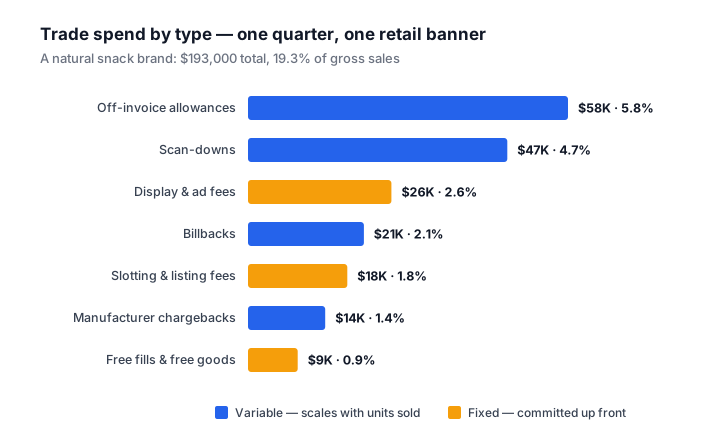
The brand's trade rate at this banner is 19.3% of gross sales, squarely inside the 15-25% range and a typical profile for a natural brand in conventional grocery. Variable spend ($140,000) is 73% of the total and scales with how much product actually sold on deal. Fixed spend ($53,000) is 27% and was committed up front regardless of outcome. That split is the first thing to look at. The $53,000 of fixed spend is the money most exposed if the promotions underdeliver, so a recap should focus its hardest scrutiny there. Turning a table like this into a verdict on whether the spend paid back is the job of trade spend analysis, and translating it into a return figure is trade spend ROI.
One caution on the calculation. The figures above are accruals until every deduction has cleared. The real total is only known once the deduction backlog for the quarter is fully reconciled, which, for plenty of brands, happens a quarter or two later, if it happens at all.
Why trade spend is hard to manage
If trade spend were just a large number, it would be manageable, because large numbers get attention. What makes it hard is that the number stays genuinely uncertain for months after the money is committed. Three structural problems explain why.
The deductions backlog
Every settled-by-deduction promotion throws off a short-pay that finance has to match to a plan. At a brand selling through Kroger, Albertsons, Whole Foods, and a KeHE-served long tail, that is hundreds or thousands of deductions a quarter. Each one needs a reason code checked, a promotion matched, an amount validated. Unmatched deductions become disputes; disputes that age past a retailer's claim window often turn uncollectible. It is routine for a mid-market brand to carry a six-figure backlog of open deductions at any moment: money it has effectively spent but cannot yet pin to a decision.
The accrual-versus-actual gap
Because trade spend is accrued before it is known, every period closes on an estimate. When the actuals come in different from the accrual, and they almost always do, the brand books a true-up. Under-accrue and a later quarter swallows a surprise charge that has nothing to do with that quarter's promotions. Over-accrue and you've understated profit and tied up money that could have funded another event. The accrual-to-actual gap is why trade spend numbers wobble, and why a recap built on accruals can land on the wrong conclusion.
Where it goes wrong
Beyond the mechanics, the same failure patterns keep recurring:
- Promotions repeated on inertia ("the Kroger buyer expects the April ad") with nobody checking whether the last one actually paid back.
- Fixed fees treated as routine. An $18,000 slotting commitment or a $26,000 display program waved through without a forecast, because it's "the cost of doing business."
- Spend tracked at the corporate parent instead of the banner. Andronicos and Safeway both roll up to Albertsons but make different pricing calls; aggregating them hides where the money actually went.
- Recaps that arrive too late. By the time a Q1 promotion is fully reconciled, the Q2 plan is already locked, so the learning never reaches a decision.
None of this is exotic. It is the default state of a brand that treats trade spend as a cost line to be tolerated rather than capital to be allocated, the reframing argued in Trade Spend: From Cost Center to Profit Driver. The first step out of that default is just seeing the spend clearly, broken out by type and banner, fast enough to act on. That's harder than it sounds when the data lives in retailer portals, distributor claims, and a deduction queue; the data challenges specific to CPG trade spend are a topic in their own right.
Doing this in Scout
Most of the difficulty above is not analytical. It is operational. The breakdown by type, the banner-level view, the reconciliation of accrual to actual, the recap that arrives in time to matter: these are repeatable tasks that brands rebuild by hand every cycle in spreadsheets.
Scout turns that into fast, repeatable analysis on your existing SPINS and retail syndicated data. Instead of rebuilding a trade spend breakdown each quarter, Scout tracks spend by type, retailer, and banner alongside the velocity it bought, so a promo recap that used to eat days of spreadsheet work becomes a view you can refresh. It won't collect your deductions or close your books, that stays with finance, but it does make the question "what did we spend, where, and did it move product" answerable in minutes instead of weeks. For why spreadsheet workflows break at scale, see Why Spreadsheets Don't Scale for CPG Sales Teams; for the post-event evaluation framework, see trade promotions analysis.
Frequently asked questions
- What is trade spend?
- Trade spend is the money a CPG brand pays to retailers and distributors to sell, promote, and merchandise its products. It covers everything from temporary price discounts to shelf-placement fees. It is paid to the trade channel rather than to consumers, and for most brands it runs 15-25% of gross sales, the largest discretionary line on the P&L after cost of goods sold.
- What is the definition of trade spend?
- The trade spend definition is the total of all allowances, fees, and deductions a brand grants to retailers and distributors in exchange for carrying, pricing, featuring, and displaying its products. It includes off-invoice allowances, scan-downs, billbacks, chargebacks, slotting fees, and display fees. On the income statement it is typically netted against gross sales to arrive at net revenue.
- What does trade spend mean?
- The trade spend meaning, in plain terms, is the cost of getting and keeping product on a retailer's shelf and moving it off that shelf. Some of it funds price cuts a shopper sees; some of it pays fixed fees for listings and displays that never touch a price. It is the cost of channel access and channel velocity combined.
- What are examples of trade spend?
- Common examples include off-invoice allowances (a per-case discount on the purchase order), scan-downs (a per-unit discount on product scanned on promotion), billbacks (allowances the retailer claims after a promotion), manufacturer chargebacks (claimed by distributors like KeHE or UNFI), slotting and listing fees for new SKUs, endcap and circular display fees, and free fills given to seed distribution.
- How do you calculate trade spend?
- Add up every allowance, fee, and deduction across all retailers and promotions in a period: off-invoice + billbacks + scan-downs + chargebacks + slotting and listing fees + display and ad fees + free goods. To get the rate, divide that total by gross sales (before deductions), not net sales. Until the deduction backlog clears, the figure is an accrual rather than a final actual.
- How does trade spend work?
- A brand and a retailer agree on a promotion and the brand commits the dollars in its trade plan. Finance accrues an estimated cost while the promotion runs. The retailer then recovers its money, often by deducting it from the next payment and attaching a reason code. Finance matches each deduction to a promotion; matches clear, mismatches become disputes.
- What is trade spend in accounting?
- In accounting, trade spend is treated as a reduction of revenue. Most of it is netted directly against gross sales to arrive at net sales, rather than sitting below the line as an operating expense. Because the true cost is unknown when a period closes, finance records it through accruals and later true-ups the estimate to the actual settled amount.
- What is a trade spend accrual?
- A trade spend accrual is finance's best estimate of what a promotion will cost, posted to the trade spend line in the period the promotion runs, before retailer deductions and claims have actually settled. It exists because trade costs are not known in real time. When the actuals arrive, the brand books a true-up for the gap between accrual and actual.
- What is the difference between trade spend and trade promotion?
- A trade promotion is a specific event: a four-week price reduction at a Kroger banner, an endcap at Sprouts. Trade spend is the money that funds it, plus money that is not promotional at all, such as slotting fees and listing fees. Every trade promotion involves trade spend, but not all trade spend funds a promotion.
- Is trade spend the same as trade marketing?
- No. Trade marketing is the discipline and team that plans how to win at retail: pricing, promotion strategy, retailer relationships, shopper marketing. Trade spend is the budget those plans consume. Trade marketing is the activity; trade spend is the dollars. The two are closely linked but should not be used interchangeably.
- What percentage of revenue is trade spend?
- For most CPG brands, trade spend runs 15-25% of gross sales, making it the largest discretionary P&L line after cost of goods sold. Established brands in competitive conventional categories often sit at the high end or above; natural and club-channel brands sometimes run lower headline rates but carry heavier fixed fees.
- What is the difference between fixed and variable trade spend?
- Variable trade spend scales with volume: scan-downs, off-invoice allowances, billbacks, and chargebacks all cost more when more units sell on deal. Fixed trade spend is committed regardless of outcome: slotting fees, listing fees, and display fees cost the same whether a promotion sells well or poorly. Fixed spend carries more risk because there is no volume floor to recover.
- Who manages trade spend at a CPG company?
- Trade spend is usually managed jointly. Sales and trade marketing plan and negotiate the promotions and fees; finance handles accruals, true-ups, and reconciling the deductions; and a sales operations or revenue growth management function often owns the planning tools and analytics. At smaller brands one trade marketing manager may carry most of it, which is part of why it is hard to control.
Summary and further reading
The essentials to carry forward from this guide:
- Trade spend is the money a CPG brand pays retailers and distributors to sell, promote, and merchandise its products: the cost of shelf access and shelf velocity.
- It includes off-invoice allowances, billbacks, scan-downs, chargebacks, slotting and listing fees, display and ad fees, and free fills, each settled and tracked differently.
- Variable spend scales with volume; fixed spend is committed up front and carries more risk because there is no volume floor under it.
- For most brands trade spend is 15-25% of gross sales, the largest discretionary line on the P&L after COGS.
- It is hard to manage because the money is accrued before it is known, settled through deductions, and only reconciled to actuals months later.
Where to go next: for the day-to-day operating discipline see trade spend management; to make the spend work harder see trade spend optimization; to judge whether past spend paid back see trade spend analysis and trade spend ROI; for the data challenges specific to this category see CPG trade spend; and for the strategic reframing of trade spend as capital allocation see Trade Spend: From Cost Center to Profit Driver; and to size the upside quickly, the ROI calculator turns your revenue, out-of-stock rate, and trade spend into an annual estimate.
See this on your own data
Scout gives CPG sales teams the analytics infrastructure they need, without spreadsheets.
Get a 15-min demoGet posts like this in your inbox
Retail data, trade promotion, and category management for CPG teams. Roughly weekly. Unsubscribe any time.