
What Is MCP? Model Context Protocol for CPG
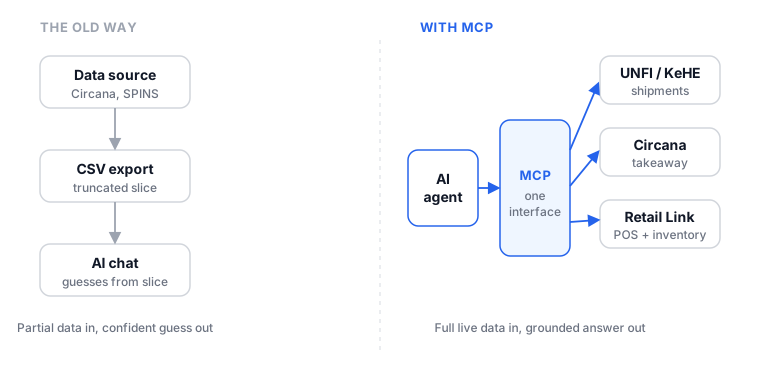
A category analyst wants to know why a brand's velocity dropped at Kroger last week. So they export a Circana file, open a chatbot, paste in as many rows as it will accept, and ask. The AI gives a confident answer based on the slice it happened to see, with no idea what got truncated. This export-and-paste ritual is exactly the problem the Model Context Protocol (MCP) is designed to end. MCP is an open standard, introduced by Anthropic and now widely adopted, for connecting AI models directly to live data and tools instead of pasting context in by hand.
If you lead a CPG data or analytics function, MCP is worth understanding now, because it is quietly becoming the wiring under the AI tools your team will use. This is a plain-English guide: what it is, why it matters for retail data, what it changes, and what it does not.
What the Model Context Protocol actually is
The Model Context Protocol is a standard interface that lets an AI agent talk to an external system through one consistent connection. You expose a data source or tool once as an MCP server, and any MCP-aware AI can read from it or act on it. The usual analogy is a universal port. Before, every AI-to-data connection was a custom cable. MCP is the standard plug, so the same agent can reach your Circana extract, your Walmart Retail Link portal, and your KeHE Connect feed through one protocol instead of a bespoke integration for each.
The practical effect for analytics is the difference between pasting a CSV into a chat and letting the AI query the source directly. Instead of the model reasoning over whatever rows fit in the window, it asks the data system the actual question and gets the actual answer back, grounded in the full dataset.
Underneath, the standard is deliberately simple. There is a client, the AI application, and a server, the thing wrapping your data or tool. The server advertises what it can do, usually as tools the model can call and resources it can read, and the client lets the model use them through the same protocol regardless of what sits behind it. The reason this matters is not elegance, it is reach. Before MCP, connecting an AI to five systems meant five custom integrations, each maintained separately. With MCP, each system is wrapped once and every MCP-aware AI can use it. That one-to-many property is why adoption moved fast through 2025, and why it is worth an executive's attention even if no one on the team has shipped an MCP server yet.
Why MCP matters for retail and CPG data
Retail analytics is the textbook case for MCP, because the whole job is reconciling many systems. A brand's answer to a single buyer question can depend on UNFI shipments, Circana takeaway, SPINS panel coverage, and Walmart Retail Link inventory at once. Today a person is the integration layer, exporting from each portal and stitching the result together by hand. MCP describes a world where an AI agent reaches each of those sources through one standard interface and assembles the answer itself.
Three things change when that happens. The answer is grounded in live data instead of a stale export. It reflects the full dataset instead of the slice that fit in a paste. And it is repeatable, because the agent runs the same query path every time instead of depending on which rows a human happened to copy. For a function where a wrong number can reach a retailer, grounded and repeatable is the entire point. This is exactly what Scout's MCP server does: it exposes a brand's connected retail data so an MCP-aware agent reaches each source through the standard interface, no export-and-paste in the loop.
It also moves the bottleneck. In most brand teams the constraint on analysis is not thinking, it is access: the analyst who knows how to pull Kroger data is on PTO, or the Retail Link login lives with one person, or the Circana extract only refreshes on Tuesdays. When an agent can reach the sources directly through a standard interface, the question stops waiting on whoever owns the export. That is a structural change in how fast a brand can react to a shelf problem, not just a faster version of the same workflow.
A worked example: before and after
Take the at-risk-SKU review a category team runs before a buyer meeting. The question is which items are losing distribution or velocity fast enough to get cut, and why.
The before version: an analyst pulls a Circana extract and a SPINS panel, exports both, builds a merge in a spreadsheet, eyeballs the decliners, then pastes the worst offenders into a chatbot for a narrative. Elapsed time is most of a morning, and the AI only ever sees the rows that survived the copy.
The after version, with MCP-style direct access: the agent queries the sales source for SKUs whose velocity fell more than 15% over the trailing four weeks, joins the distribution trend, and returns a ranked list with a reason for each, all grounded in the full dataset. Elapsed time is under two minutes, and nothing was truncated. The analyst's job shifts from assembling the data to deciding what to do about it. That shift, from data assembler to interpreter, is the same one we describe in what AI actually changes for brand teams.
The part that is easy to miss is repeatability. Run the before version two weeks in a row and you get two slightly different analyses, because a person made a hundred small choices about which rows to copy and how to build the merge. Run the after version and the agent executes the same query path both times, so the only thing that changed is the data. For a recurring review that a buyer sees every month, that consistency is not a nicety. It is the difference between a process you can defend and a number you have to re-derive every time someone asks how you got it.
What MCP does and does not change
It is worth being precise, because MCP is new enough that the hype is running ahead of it. MCP changes how an AI connects to data. It does not, by itself, make the data correct, govern who can see what, or know that a Circana week ends on Sunday. A standard plug is not domain knowledge.
- MCP does not fix bad data. If a retailer reships a corrected file or a UPC is miscoded, an agent reaching it through MCP will read the same bad rows. Grounding is only as good as the source.
- MCP does not replace governance. Direct AI access to live data makes permissions and auditability more important, not less. Who can ask what, and is every query logged, are questions you answer around MCP, not with it.
- MCP does not supply retail meaning. The protocol moves data; it does not know dollars from equivalized units or shipments from takeaway. That understanding still has to live in the tool on top.
Read plainly, MCP is plumbing: important, enabling, and not a strategy on its own. The value still comes from what sits on top of the connection.
The governance point deserves a second look, because it is the one most likely to surprise a leadership team. The instinct is to treat direct AI access as a security downgrade, something to lock down. The better framing is that it raises the bar in a way that is good for you: when every answer comes from a logged query against a permissioned source, you get an audit trail that the export-and-paste era never had. Today, nobody can tell you which version of which spreadsheet produced the number in last quarter's deck. A well-built agent setup can. The work is making sure the permissions and the logging are real before you scale access, not discovering you needed them afterward.
Where this leaves a CPG data team
The takeaway for a brand is that the grounded-answer loop is something you can adopt now, not a someday-when-the-ecosystem-matures bet. The benefit is an AI that answers from your live retail data, grounded in the full dataset, with its work traceable, instead of a chatbot guessing from a pasted slice. The fastest way there is a platform that already speaks retail and already exposes your data through MCP, so you plug an agent into a working server rather than build the connection yourself.
A practical sequence for a data leader who wants to be ready without overcommitting: first, get your retail feeds into one governed place, because MCP or not, an agent reaching scattered exports inherits the scatter. Second, pick a single high-frequency workflow, the weekly at-risk-SKU review is a good one, and prove the grounded-answer loop on it end to end. Third, insist on traceability and logging from day one, so the audit trail is a feature you built rather than a gap you patch. Do those three and you are positioned to plug into the MCP ecosystem the moment it helps, instead of treating the standard as a project in itself.
Scout is built around exactly that outcome. Its AI analyst answers questions over a brand's connected retail data, UNFI, KeHE, Circana, SPINS, and Retail Link, and every number it returns traces back to the source rows and formula. Scout exposes that same connected data through an MCP server, so an MCP-aware agent like Claude can query your retail data directly and get back grounded, full-dataset answers through the standard interface, with every figure still traceable to its source. That is the grounded, repeatable behavior MCP is meant to standardize, available now without a data-engineering project on your side. If you want to see grounded AI analysis on your own retailer data, explore Scout's AI retail analytics platform and book a demo below.
Frequently asked questions
- What does MCP stand for?
- MCP stands for Model Context Protocol. It is an open standard, introduced by Anthropic in late 2024 and widely adopted since, for connecting AI models to external data sources and tools through one consistent interface rather than a custom integration for each system.
- How is MCP different from pasting data into a chatbot?
- Pasting puts a fixed slice of data into the model's context, limited by whatever fits and whatever the person copied. MCP lets the agent query the source directly, so the answer reflects the full live dataset and runs the same query path every time instead of depending on a manual copy.
- Does MCP make AI answers accurate by itself?
- No. MCP standardizes the connection between an AI and a data source. It does not clean the data, enforce who can see what, or supply domain knowledge like the difference between shipments and consumer takeaway. Accuracy still depends on the source data and the tool built on top.
- Does Scout have an MCP server?
- Yes. Scout exposes a brand's connected retail data, UNFI, KeHE, Circana, SPINS, and Retail Link, through an MCP server, so an MCP-aware agent like Claude can query it directly and get grounded, full-dataset answers with every number traceable to its source. You also get that same grounded behavior through Scout's own AI analyst, without standing up anything yourself.
See this on your own data
Scout gives CPG sales teams the analytics infrastructure they need, without spreadsheets.
Get a 15-min demoGet posts like this in your inbox
Retail data, trade promotion, and category management for CPG teams. Roughly weekly. Unsubscribe any time.