
AI Center of Excellence
An AI center of excellence for CPG
A center of excellence is how a company turns scattered AI experiments into a standard everyone can rely on: one team that owns the tools, sets the definitions, and gets the rest of the org actually using them. This is a practical guide to building one in a CPG business, and where the effort pays off or stalls.
What an AI center of excellence is
An AI center of excellence (CoE) is the group inside a company that owns how AI gets used. It sets the standards, maintains the tooling, curates the use cases worth funding, and holds the bar for what a trustworthy answer looks like. It exists so AI stops being a pile of disconnected pilots and becomes something the sales, category, and finance teams can lean on.
In a CPG business the thing it governs is commercial analytics: how a promotion’s lift is measured, how ACV is calculated, which number wins when SPINS and a retailer portal disagree, and which of those questions an AI assistant may answer on its own. The CoE is where those calls get made once, for everyone, instead of drifting from one analyst’s spreadsheet to the next.
You do not need a data-science department to have one. A mid-market brand’s CoE might be two people and a clear charter. The size that matters is the scope of what it standardizes, not the headcount.
Why CPG brands are standing them up now
CPG teams did not go looking for an AI program. They ended up with one anyway, because every vendor shipped a copilot and every analyst started pasting data into a chatbot. The result at most brands is shadow AI: useful in pockets, ungoverned, and impossible to trust at the reporting layer.
A few pressures push brands to formalize it. Retail and syndicated data arrive in more formats every year (Retail Link, KeHE Connect, SPINS, Circana, NielsenIQ), and reconciling them by hand is where analyst weeks go. Trade spend is one of the largest lines on the P&L, and most brands still cannot cleanly separate promoted lift from baseline. And the distance between an AI pilot that demos well and an AI capability the team uses every Monday is wide, which is exactly the distance a CoE exists to close.
The honest reason to build one is not that AI is exciting. It is that ungoverned AI on unreconciled data produces confident wrong answers faster, and a CoE is the cheapest way to stop that.
Three ways to organize it
There is no single shape. The three common ones trade central control against local speed. Pick by the size of your team and how consistent your numbers have to be across accounts.
| Model | Best for | How it works | Main risk |
|---|---|---|---|
| Centralized | Smaller teams, or brands that need one consistent number across every account. | One team builds, owns, and runs every AI workflow. Questions come in, reviewed answers go out. | It becomes a bottleneck. The business waits in a queue behind the CoE. |
| Hub-and-spoke | Mid-size to large brands with distinct category or channel teams. | A central hub owns the standards, the tooling, and the hard builds. Embedded champions (the spokes) apply them inside each team. | It only works if the hub enables the spokes instead of policing them. |
| Federated | Large, mature organizations that already run on a shared platform. | Each team does its own AI work against shared standards and a shared data platform. | Standards drift the moment the shared platform stops being the easiest path. |
Most CPG brands under a few hundred million in revenue are best served by a centralized-leaning hub-and-spoke: a small core that owns the data foundation and the definitions, plus named champions in category and sales who drive daily use.
The seven pillars of an AI CoE
A center of excellence is a set of functions, and it is only as strong as its weakest one. Skip governance and you get fast wrong answers. Skip adoption and you get a great tool nobody opens.
1. Strategy and sponsorship
An executive owner who ties the CoE to a P&L outcome, trade-spend efficiency or distribution gains, and protects its funding. Without a sponsor, the CoE is the first line cut in a tight quarter.
2. Governance and trust
The rules for what AI may answer unsupervised, how each metric is defined, and how an answer gets checked. In CPG this is where ACV, TDP, and baseline-versus-incremental get pinned down so the model cannot improvise them.
3. People and roles
The mix of data engineering, analysis, and domain expertise, plus the translators who turn a category question into something the system can answer.
4. Data and platform
The unglamorous core: harmonized retailer and syndicated data in one place. AI on a clean data layer is a real speed-up. AI on unreconciled feeds is a faster way to be wrong. See how syndicated data gets reconciled.
5. Use-case portfolio
A managed, ranked list of what the CoE is working on, ordered by value and feasibility, so effort goes to the promo and distribution questions that move money rather than the demo that impressed someone.
6. Adoption and enablement
The work of getting people to actually use the tools: training, templates, office hours, and quick wins. Most CoEs underfund this pillar, and it is the one that decides whether the other six mattered.
7. Measurement
A way to prove the CoE earns its keep: usage, time-to-answer, decisions influenced, and dollars moved. Measure outcomes, not the number of models shipped.
Who sits in it
A CoE is a small number of clearly-owned roles. At a mid-market brand one person often wears two hats. The point is that each job has an owner.
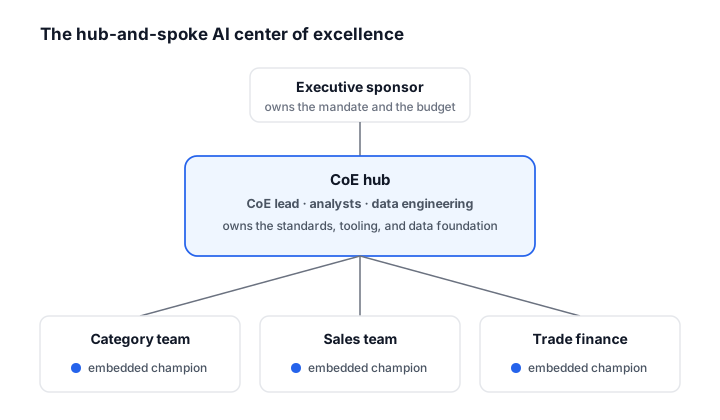
- Executive sponsor
- Owns the mandate and the budget. Usually a VP of Sales, Category, or Insights, or the finance side where trade spend is the target.
- CoE lead
- Runs the function day to day: sets priorities, owns the standards, and reports outcomes to the sponsor.
- Data engineering
- Builds and maintains the harmonized data foundation the AI answers from. The most common thing brands try to skip, and the most common reason a CoE fails.
- Analysts and data scientists
- Turn business questions into models and reviewed answers, and own the worked examples the rest of the org copies.
- Champions and translators
- Embedded in category and sales. They speak both languages, drive daily use, and surface the questions worth automating. This is probably the person reading this page.
- Domain experts
- Category managers, trade-finance, and revenue-growth leads who define what "right" means for their area and keep the AI honest.
The AI-CoE maturity model
Most centers of excellence move through the same five stages. Find where you are. The useful question is how to advance one stage, not how to leap to the end.
| Stage | What it looks like | How to advance |
|---|---|---|
| 1. Ad hoc | Individuals paste data into chatbots. No standards, no shared tooling. Useful in pockets and impossible to trust. | Name an owner and pick one high-value use case. |
| 2. Piloting | A few sanctioned pilots. They demo well but rarely reach the weekly workflow. | Harden one pilot into a tool the team uses, and measure whether they do. |
| 3. Scaling | A real data foundation and a handful of trusted workflows. Adoption is uneven across teams. | Fund enablement and champions, and standardize the metric definitions. |
| 4. Embedded | AI-assisted analysis is the default for promo, distribution, and category work. People trust the numbers. | Push decisions, not just answers, and tie usage to P&L outcomes. |
| 5. AI-native | The commercial process is built around AI-generated analysis, with humans reviewing and deciding. New questions get answered in hours. | Keep the data foundation and governance ahead of the appetite. |
The adoption playbook: turning pilots into daily use
This is the part most CoEs get wrong. A tool nobody uses is a cost, not a capability, and getting people to use it takes a real program. This is the sequence that works.
- 1
Start where the pain and the data are both real
Pick a question the team already asks every week and already has usable data for, like which promotions actually paid back. A quick, correct answer to a real question buys more adoption than a flashy answer to a hypothetical one.
- 2
Ship a worked example, not a platform
Give the team one reviewed analysis they can copy, with the numbers and the method visible. People adopt a template they trust faster than a blank prompt box.
- 3
Make the right way the easy way
If the sanctioned tool is slower than pasting into a chatbot, people paste into the chatbot. Remove the friction, pre-connected data and saved views, so the governed path wins on convenience, not policy.
- 4
Recruit champions, not compliance
One respected category manager who uses the tool in a Monday meeting converts more people than a mandate. Give champions early access, credit, and a direct line to the CoE.
- 5
Measure usage first, then decisions
Track who actually uses it in a normal week, then whether it changed a decision: a promo cut, a distribution push. A login is not a decision, and deployment is not adoption.
- 6
Close the loop out loud
When the CoE's analysis drives a win, say so, with the number. Nothing spreads adoption like a peer's result the reader wishes were theirs.
Where an AI CoE creates value in CPG
A CoE earns trust by being useful on the questions CPG teams actually lose sleep over. These are the highest-value starting points, and each maps to data most brands already have.
Trade promotion and trade spend
Separating promoted lift from the baseline that would have sold anyway, and tying it to what the promotion cost. The biggest recoverable line for most brands, and the clearest early win. Trade promotion management · post-promo lift.
Distribution and assortment
Finding where a SKU is under-distributed relative to its velocity, using ACV-weighted distribution and TDP, then closing the gap.
Syndicated-data harmonization
Making SPINS, Circana, and NielsenIQ agree with each other and with retailer portals, so one number means one thing across accounts.
Demand and on-shelf signals
Reading sell-through and on-shelf-availability trends early enough to act, and sharpening the demand forecast.
Category reviews
Assembling the read a category manager would otherwise spend days building, with share, velocity, and distribution in one place.
Ask-your-data workflows
Letting a category or sales lead ask a question in plain language and get a checked answer instead of filing a request. The agentic layer on top of a real data foundation.
How to know it is working
A CoE that reports how many models it shipped is measuring the wrong thing. These are the metrics a sponsor should ask for.
- Weekly active use
- How many people in the target teams actually use it in a normal week. The first honest read on whether it took.
- Time to answer
- How long from question to a trusted answer, before and after. This is the analyst time the CoE gives back.
- Decisions influenced
- How often the analysis changed an action: a promo cut, a distribution push, an assortment call. Answers that change nothing do not count.
- Dollars moved
- Trade spend recovered, incremental distribution captured, waste avoided. Tie it back to the sponsor's P&L line.
- Answer accuracy
- How often the AI answer survives a human check. A CoE that cannot measure this is asking the org to trust a black box.
Why AI centers of excellence stall
They fail in a small number of predictable ways. Every one is avoidable.
No executive owner
A CoE without a sponsor tied to a P&L outcome is a hobby, and it gets cut in the first tight quarter.
Building on unreconciled data
AI on feeds that do not agree produces confident, wrong, fast answers. The data foundation is not the boring prerequisite. It is the whole thing.
Optimizing for pilots
Demos are easy and daily use is hard. A CoE measured on pilots launched will keep launching pilots nobody opens.
Black-box distrust
If the team cannot see how a number was reached, they will not stake a decision on it, and adoption stalls. The method has to be visible.
Measuring activity, not outcomes
Models shipped and dashboards built are activity. Decisions changed and dollars moved are outcomes. Report the second kind.
Build vs. buy: where Scout fits
Some of a CoE you have to build yourself: the sponsor, the charter, the champions, and the calls about what “right” means for your categories. Nobody can outsource those. But the two hardest, slowest pillars, the harmonized data foundation and the trustworthy analytics on top of it, are exactly where a specialized partner saves a brand a year.
Scout is an AI-native retail analytics platform for CPG, and the team that runs it. It ingests the retailer and syndicated data a brand already has (Retail Link, KeHE, SPINS, Circana, NielsenIQ), harmonizes the item codes and week definitions, and computes distribution, velocity, and promotion lift once, correctly. The metrics are defined the standard way and the method is written down on Learn and in the glossary, not sealed inside a model you take on faith. That is the data- and-platform pillar, plus a measurement standard, off the shelf.
Two honest boundaries. Scout is not a retailer portal; it reads what those systems produce and cannot get you a login to one. And it is built for the demand side, sell-through, distribution, promotion and trade-spend, not supply planning. Within that scope it is the fastest way to stand up the parts of an AI CoE that otherwise take a brand a year and a data-science bench. Where a brand wants the function operated alongside its team, the same people engage directly.
Common questions
- What is an AI center of excellence?
- An AI center of excellence is the team inside a company that owns how AI is used: it sets the standards, maintains the tooling, curates the use cases worth funding, and holds the bar for a trustworthy answer. In CPG it governs commercial analytics, so promotion lift, distribution, and syndicated-data questions get answered one consistent way instead of drifting from one analyst to the next.
- Centralized or federated: how should a CPG brand structure one?
- Most CPG brands under a few hundred million in revenue do best with a centralized-leaning hub-and-spoke model: a small central team owns the data foundation and the metric definitions, and named champions in category and sales drive daily use. Fully federated models fit large, mature organizations that already run on a shared platform.
- How big does an AI center of excellence need to be?
- It can start with two people and a clear charter. What matters is the scope of what it standardizes, not headcount. A mid-market brand's CoE is often a lead plus a data engineer, supported by champions who keep their day jobs.
- How do you measure the ROI of an AI center of excellence?
- Measure outcomes, not activity: weekly active use, time from question to trusted answer, decisions the analysis changed, and dollars moved such as trade spend recovered or distribution gained. The number of models shipped is a vanity metric.
- Why do AI centers of excellence fail?
- The common causes are a missing executive sponsor, building on unreconciled data, optimizing for pilots instead of daily use, black-box tools the team will not trust, and measuring activity instead of outcomes. Each one is avoidable.
- What should a CPG AI CoE work on first?
- Start where the pain and the data are both real, usually trade-promotion effectiveness or distribution gaps. A quick, correct answer to a question the team already asks every week earns more adoption than an ambitious project that takes a quarter to show anything.
- Is this really AI, or manual configuration with an AI layer on top?
- A fair challenge, and the test is whether anything happens without you asking. Configuring a dashboard and then pointing a chat box at it is the pattern most tools ship. The useful version runs on its own: it notices the velocity drop, the stalled SKU and the promotion that underperformed, and tells you before you thought to look.
- Does it tell me what to do, or just show me numbers?
- A number is not a decision. The output that earns its place names the action: reorder these items for these stores, run this promotion at this depth, look at this account because something changed. Charts are how you check the reasoning, not the deliverable.
Tell us what you’re working on
A 30-minute conversation to scope fit. Pick a time that works for you.