
What Is Trade Promotion? Definition, Types, Examples
A trade promotion is the money, or free product, a brand pays its retailers and distributors to push more volume to shoppers. In practice that means a lower shelf price, a spot in the weekly ad, an end-of-aisle display, or a deeper discount on the next truckload. For most consumer-packaged-goods brands it is one of the largest lines on the P&L, often second only to the cost of the goods themselves, and it is the single biggest lever a brand has over how a product sells at retail.
The defining feature of a trade promotion is who gets paid. The money flows from the manufacturer to the trade: the retailers, wholesalers, and distributors that stand between the brand and the shopper. It buys something the brand cannot get on its own, namely distribution, merchandising, and a temporary price cut at the shelf. That is what separates it from a coupon or a TV ad. A trade promotion is a business-to-business negotiation, not a marketing campaign.
What is trade promotion?
Trade promotion is any short-term incentive a manufacturer offers a retail customer to drive sales of its products. The incentive is almost always tied to an action the brand wants the retailer to take: drop the shelf price for four weeks, run the item in this month's circular, build a display by the front lobby, or take a larger order ahead of a holiday. In return the brand funds part of the cost, through a discount, an allowance, a flat fee, or free goods.
Why does the brand pay at all? Because the retailer owns the shelf. A brand cannot unilaterally lower the price a shopper sees, claim ad space, or earn a second facing; those are the retailer's decisions. Trade promotion is how a brand rents those decisions for a window of time. Done well, the promoted price and visibility lift sell-through enough that both sides come out ahead. The retailer moves more units and earns margin, and the brand sells incremental volume it would not have sold at the regular price.
Trade promotion is the promotional slice of a brand's broader trade spend. The two terms get used interchangeably, but they are not identical: trade spend also covers everyday, non-promotional money like slotting fees and base allowances. The promotional part, the price reductions, features, and displays tied to a specific event, is the trade promotion. For the wider picture of every dollar a brand pays the trade, see the guide to trade spend.
Trade promotion vs. consumer promotion
It helps to contrast trade promotion with its sibling, consumer promotion. Both aim to sell more product, but they pull a different lever and pay a different party. A trade promotion pays the retailer to lower the price or raise visibility; a consumer promotion gives value to the shopper directly. A coupon, a loyalty-points offer, a mail-in rebate, or an in-store sample are all consumer promotions. The brand reaches past the retailer and incentivizes the buyer at the point of decision.
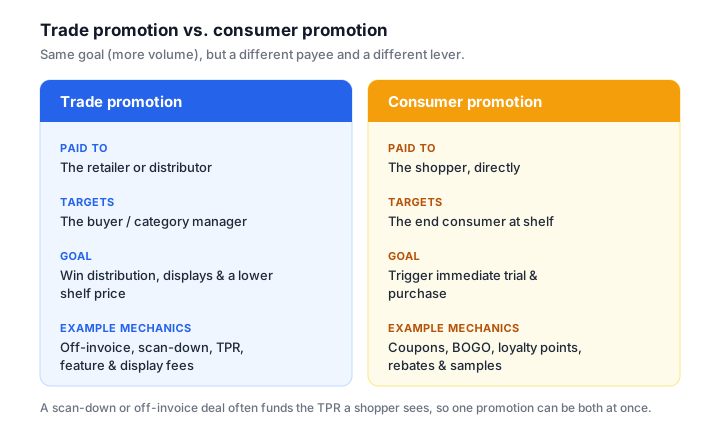
The line blurs in practice, because a trade promotion is often what makes a consumer-facing deal possible. When a shopper sees a temporary price cut on the shelf, the brand usually funded that markdown through a trade allowance paid to the retailer. The shopper experiences a price; the brand and retailer experience a negotiated promotion behind it. One event can be both at once, which is exactly why measuring who drove the lift gets complicated.
Types of trade promotion
Trade promotions come in a handful of recurring forms. Some change the price a shopper pays, some change where and how the product appears in the store, and some do both. The mechanics below are the building blocks. A single promotional event usually combines two or three of them: a temporary price reduction funded by a scan-down and supported by an ad feature, for example.
| Type | What it is | How the shopper sees it |
|---|---|---|
| TPR (temporary price reduction) | A brand-funded markdown on the shelf price for a set window | A lower everyday-looking price, no coupon to clip |
| Feature | Inclusion in the retailer's weekly ad, circular, or app | The product called out in the flyer, email, or app |
| Display | Secondary placement off the home shelf: endcap, shipper, or lobby stack | A prominent stack or endcap, often with a price call-out |
| BOGO | Buy-one-get-one, funded as a deep temporary deal | A "buy one, get one free" or half-off tag at the shelf |
| Off-invoice allowance | A per-case discount deducted on the purchase invoice | Usually invisible; it funds the TPR or display |
| Scan-down (scanback) | A per-unit allowance the brand pays on units actually scanned during the deal | Funds the shelf discount; the brand pays only on what sells |
| Slotting / listing fee | A fee to win or hold shelf space for an item | Nothing directly; it buys the product's presence |
The first four (TPR, feature, display, and BOGO) are what the shopper actually encounters. The last three are funding mechanics: how the brand pays for those shopper-facing events. The distinction matters because two promotions that look identical on the shelf can have very different economics depending on whether they were funded off-invoice or on a scan-down.
How trade promotions are funded
The funding method decides who carries the risk and how the money gets accounted for. There are four common structures, and most brands use a mix:
- Off-invoice allowance: the discount comes straight off the invoice when the retailer buys. It is simple and the retailer loves the immediate margin, but the brand pays on every case ordered whether or not it sells through, which invites forward buying.
- Bill-back and scan-down: the brand reimburses the retailer after the fact, on cases shipped (bill-back) or on units actually sold during the deal (scan-down). It pays for performance and limits forward buying, but it creates a claim the brand has to reconcile against the agreement, a frequent source of deductions.
- Lump-sum and fixed funds: a flat payment for a specific placement such as ad fees, display fees, market development funds (MDF), or slotting. The cost is fixed and known up front, independent of how many units move.
- Free goods and free fills: product given instead of cash, common at launch or to seed a new display. It avoids an invoice but still carries a real cost of goods the brand has to book.
Whatever the structure, trade promotion is the main bridge between a brand's gross sales and its net sales, the gross-to-net gap. Every allowance, scan-down, and fee comes off the top line before the brand recognizes revenue. That is why finance and sales watch it so closely, and why getting the trade spend math right is a P&L issue, not just a sales-team one.
How trade promotions are measured
A trade promotion is only worth running if it sells volume the brand would not have sold anyway. Measuring that comes down to four ideas. The baseline is what the product would have sold with no promotion, the counterfactual you compare against. Lift is the total promoted volume minus that baseline. Incremental volume is the share of the lift that is genuinely new, after you strip out the units a shopper simply bought early or pulled from a competing SKU. ROI is the incremental profit those units generated divided by what the promotion cost.
The hard part is honesty about the baseline and the incrementality. Three effects routinely inflate a promotion's apparent success: forward buying, where shoppers and retailers stock up at the deal price and simply buy less afterward; the post-promotion dip, the soft weeks that follow; and cannibalization, where a deal on one size or flavor steals volume from another the brand already owns. A promotion that looks like a big lift can be net-flat once those are netted out. Getting it right takes a clean, defensible baseline built from syndicated data or POS movement, not a guess. For the full method, see trade promotion effectiveness and CPG promotion performance; to pressure-test a single event's economics, try the ROI calculator.
Trade promotion examples
Take a natural snack brand that runs a four-week temporary price reduction at a regional grocer, dropping the shelf price from $3.99 to $2.99. It funds the markdown with a $0.75-per-unit scan-down and adds a $5,000 ad feature in the chain's weekly circular. The item normally sells about 1,200 units a week; during the promotion it sells 3,400. The raw lift is 2,200 units a week. But two of those four weeks of gain turn out to be shoppers stocking up, so the brand counts roughly 1,500 truly incremental units a week, then weighs the margin on those against the scan-down plus the ad fee to decide whether the event repeats.
A pure visibility play looks different. A beverage brand takes a front-lobby display for a holiday week, funded by a 15% off-invoice allowance on the cases the retailer orders to fill it. There is no shelf-price change; the bet is that the placement alone drives trial. Because the funding is off-invoice, the brand pays the 15% on every case shipped into the display. So the measurement question becomes whether the display sold through, or whether the retailer over-ordered against an allowance it knew was coming. That is the difference between a display that paid back and a forward-buy dressed up as a promotion.
Where Scout fits
Trade promotion only pays off when a brand can see what each event actually returned, and that is a measurement problem most brands still solve in spreadsheets, late and by hand. Scout builds a no-promotion baseline for every item at every retailer from syndicated and POS movement, turns actual sales into incremental units and ROI, and ties each result back to what the deal was funded to cost. That measured history is the input to running promotions well and to trade promotion management and optimization. Once you can trust the numbers, you can run trade promotion management on a real calendar and move toward optimization, repeating what works and cutting what does not. For related reading, see trade promotion analysis.
Trade promotion definition
A trade promotion is a short-term, brand-funded incentive paid to a retailer, wholesaler, or distributor in exchange for a specific selling action, such as a lower shelf price, ad space, or a display, over a set window. That one sentence holds the whole meaning. The money moves from manufacturer to trade, the incentive is temporary, and it is always tied to something the brand wants the retailer to do.
Three questions separate a trade promotion from everything nearby. Who pays? The manufacturer. Who gets paid? The trade, not the shopper. What does it buy? A time-bound action at retail, whether that is a price cut, a feature, or a display. A payment that fails any of those is something else. A coupon pays the shopper. A slotting fee buys permanent shelf access rather than a promotional event. An everyday base allowance carries no event attached.
Why does the definition matter? Because of where the money sits. For a typical CPG brand, promotional trade dollars are one of the largest lines on the P&L, and they fund decisions the brand cannot make alone. A brand does not own the price a shopper sees or the space the product occupies. The retailer does. Trade promotion is the contract that rents those decisions for a few weeks at a time.
Trade promotion strategies
Most trade promotion strategy comes down to choosing the right mechanic for the job. The shopper-facing levers are price reductions, features, displays, and combinations of them. Each one moves volume in a different way, and each costs the brand differently. Picking well is a question of what you want the promotion to do.
Price reductions
A temporary price reduction lowers the shelf tag for a set window. It is the default lever when the goal is raw unit velocity on an item shoppers already know and buy. Price cuts work hardest on established, price-sensitive products, where a few points off pulls volume forward. The risk is that a deep or frequent cut trains shoppers to wait for the deal and erodes the regular price. Use it as an occasional push, not a standing condition.
Features and displays
A feature puts the item in the retailer's weekly ad, circular, or app, buying attention before the shopper reaches the store. A display moves the product off its home shelf to an endcap, a lobby stack, or a shipper, which buys attention inside the store. Both are visibility plays. They earn their keep when the job is reaching shoppers who were not already looking for the item, at a launch, a seasonal peak, or against a new competitor. Visibility usually lifts volume more efficiently than price alone, which is why a feature or display paired with a modest markdown tends to beat a deep cut on its own.
Most real programs combine these. A common pattern stacks a price reduction with a feature and a display for a single event, so the shopper sees a deal, hears about it in the ad, and walks past a prominent stack of it. The strategy question is not which lever to use but which mix the event justifies, and then whether the lift it returned was worth what it cost. For how brands score that after the fact, see CPG promotion performance and the deeper guide to trade promotions analysis.
Frequently asked questions
- What is trade promotion in simple terms?
- It is money a brand pays its retailers and distributors to sell more of its product, usually by lowering the shelf price for a while, running it in the ad, or building a display. The brand cannot do those things itself because the retailer controls the shelf, so it pays the retailer to do them.
- What is the difference between trade promotion and consumer promotion?
- A trade promotion pays the retailer (to discount, feature, or display the product); a consumer promotion gives value to the shopper directly (coupons, BOGO, loyalty points, rebates, samples). A shelf price cut a shopper sees is often funded by a trade promotion behind the scenes, so one event can be both.
- What are the main types of trade promotion?
- The shopper-facing types are temporary price reductions (TPR), ad features, displays, and BOGO offers. Behind them sit the funding mechanics that pay for those events: off-invoice allowances, scan-downs (scanbacks), lump-sum ad and display fees, and free goods.
- Is trade promotion the same as trade spend?
- Not quite. Trade spend is the umbrella term for every dollar a brand pays the trade, including non-promotional money like slotting and base allowances. Trade promotion is the promotional portion: the price cuts, features, and displays tied to a specific event. See the trade spend guide for the full breakdown.
- How do you measure whether a trade promotion worked?
- Compare promoted sales to a no-promotion baseline to get lift, strip out forward-buying and cannibalization to get the truly incremental volume, then divide the incremental profit by what the promotion cost to get ROI. A clean baseline from syndicated or POS data is what makes the number trustworthy.
See this on your own data
Scout gives CPG sales teams the analytics infrastructure they need, without spreadsheets.
Get a 15-min demoGet posts like this in your inbox
Retail data, trade promotion, and category management for CPG teams. Roughly weekly. Unsubscribe any time.