
Sales Velocity in CPG: How Well a Product Sells
Sales velocity in CPG measures how fast a product sells in the stores that actually carry it, not how much it sells in total. It is the rate of sale: the units or dollars a product moves per store, per week, normalized for the size of the retail footprint behind the number. Total sales tell you how big a product is. Velocity tells you how well it works. Those are different questions, and confusing them is how brands end up defending distribution they should cut and cutting distribution they should defend.
A category manager at a regional grocer is looking at two items in the cold-brew set. One did $2.0M last year, the other $2.1M, a rounding error apart. On total sales alone they are the same bet. But one sits in a fifth of his stores and the other in three-quarters of them, and the moment he divides each item's sales by the shelf space behind it, the ranking flips: the smaller-looking item is selling roughly three times as fast everywhere it lands. He keeps the $2.0M item and cuts the $2.1M one. Velocity, not total sales, made that call, and it is the number that settles shelf space in every category review.
This guide covers what sales velocity is, the two measures CPG teams actually use, when each is the right lens, how velocity differs from total sales, and how it surfaces the hidden winners and losers a total-sales report buries. It closes with a worked example and how Scout computes velocity on harmonized data.
What is sales velocity in CPG?
Velocity is a rate, not a total. Where total sales answer "how many dollars did this product generate," velocity answers "how fast does it sell wherever it is on the shelf." You get there by dividing sales by some measure of the distribution behind them, so two products of very different sizes can be compared on equal footing.
The cleanest way to hold the relationship is a simple identity: sales equal distribution times velocity. Distribution is how widely a product is carried, measured by %ACV distribution or total distribution points. Velocity is the sales it earns per point of that distribution. Grow distribution and total sales rise even if the product sells no faster; grow velocity and the same shelf space produces more. Pull the two apart and you can see which lever is actually moving.
This is why velocity, not total sales, is the number a retail buyer judges a SKU on. A buyer cannot fairly compare a regional challenger's total dollars to a national brand's, the scales are nowhere near each other. But velocity, sales per store or per point of distribution, is apples to apples. It is the metric that earns a facing, and the metric that loses one.
The two main velocity measures
Velocity always means rate of sale, but there are two standard ways to express it, and they normalize by different things. CPG teams use both, often side by side.
Dollars per $MM ACV (the syndicated standard)
ACV stands for all-commodity volume: the total dollar size of a store across everything it rings, not just your category. Dollars per $MM ACV divides a product's sales by the all-commodity volume, in millions of dollars, of the stores that carry it. It is the velocity measure syndicated providers like SPINS, Circana, and NielsenIQ report, because it normalizes for both how many stores carry an item and how big those stores are.
Worked in numbers: a product doing $2.0M across stores that together ring $220MM in all-commodity volume has a velocity of about $9,100 per $MM ACV. A more broadly distributed product sitting in $700MM of ACV and doing $2.1M comes in at roughly $3,000 per $MM ACV. The second item posts more total dollars while occupying more than triple the shelf opportunity to do it. Same sales, very different velocity.
Units per store per week (the rate of sale)
The second measure is more operational: units (or dollars) divided by the number of stores selling the item and the number of weeks. It produces an intuitive figure, "this SKU moves about six units a week in an average store," that a buyer or a sales rep can hold without a calculator. It is the natural unit for replenishment decisions and for the question every line review asks: is this item earning its facing?
Its limitation is the flip side of its simplicity: it does not adjust for store size. A unit sold in a 60,000-square-foot Kroger counts the same as a unit sold in a small natural grocer, even though the two stores are nowhere near comparable. That is exactly the distortion dollars per $MM ACV is built to remove.
When to use each velocity measure
Both numbers are velocity; the right one depends on the comparison you are making. Dollars per $MM ACV is the cross-market measure. Reach for it when you are comparing across retailers or channels of very different size, benchmarking yourself against the category, or reading a syndicated report, anywhere store size would otherwise contaminate the comparison.
Units per store per week is the within-set, operational measure. Reach for it when you are talking to a single buyer about a single chain, planning replenishment, or reading a brand-new item before it is in enough stores to benchmark. A quick guide:
- Comparing across retailers or channels of different size: dollars per $MM ACV.
- Talking to a buyer about one chain, or planning replenishment: units per store per week.
- Reading a brand-new item's early traction: units per store per week first, then dollars per $MM ACV once it is broadly distributed enough to compare.
- Benchmarking yourself against the category: dollars per $MM ACV, because that is what syndicated data reports.
Velocity vs. total sales
The single most useful thing velocity does is separate demand from distribution, two forces that total sales mash together. Total sales reward a product for being in a lot of places. Velocity isolates how well it sells once it gets there. A product can post big total sales on weak velocity, propped up almost entirely by broad shelf presence, or modest total sales on strong velocity, held back only by where it is not yet stocked.
This is why a rising total-sales line can be a trap. A brand that adds stores faster than its per-store rate of sale erodes will show top-line growth while quietly diluting, and the falling velocity is the leading indicator of the delistings to come. Gaining total distribution points while velocity slips is a warning, not a win. Reading the two together, rather than celebrating the total, is the difference between durable growth and borrowed time. Our velocity, share, and TDP decision tree walks through which lever to pull when they disagree.
How velocity exposes hidden winners and losers
Because velocity strips out distribution, it surfaces two kinds of SKU that a total-sales ranking hides completely.
- The hidden winner: modest total sales, high velocity, thin distribution. The product sells hard wherever it is placed but simply is not in enough places. The move is to expand distribution, and the high velocity is the exact proof point that wins a buyer's yes.
- The hidden loser: large total sales, low velocity, broad distribution. The dollars look healthy only because the item is nearly everywhere. On a per-store basis it trails the set, which makes it the first candidate cut in a category review. The move is to fix the velocity, through price, pack size, or merchandising, or concede the facing before the buyer takes it.
This is not a theoretical framing; it is how buyers run line reviews. They rank the set by velocity, or by sales per point of distribution, and trim from the bottom. A brand watching its own velocity sees that cut coming a quarter or two ahead, and can act, expanding the winner and shoring up the loser, while it still has a say.
Worked example: two SKUs, same sales, opposite futures
Return to the category manager's cold-brew set. Two SKUs land within $100K of each other on total sales, so a total-sales scorecard treats them as equals. Normalize for distribution and they could not be more different:
| SKU | Total $ sales (52 wks) | %ACV distribution | Velocity ($/$MM ACV) | The read |
|---|---|---|---|---|
| Bright Roast 12 oz (challenger) | $2.0M | 22% | $9,100 | Hidden winner. Strong pull on thin distribution; the case for expansion writes itself. |
| Harbor 32 oz (incumbent) | $2.1M | 70% | $3,000 | Hidden loser. The dollars come from shelf presence, not demand. First cut in the next review. |
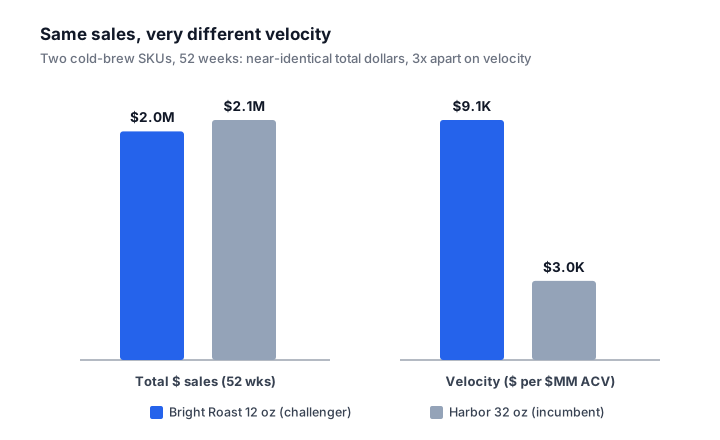
On total dollars the two tie. On velocity the 12 oz challenger runs about three times the 32 oz incumbent, because it produces nearly the same sales from less than a third of the distribution. The buyer who ranks the set by velocity expands the challenger and delists the incumbent, even though the incumbent shows more total dollars today. A brand reading only its total-sales report would lobby to protect exactly the wrong SKU, and lose the argument it should have won.
Doing this in Scout
The math here is not the hard part; the data is. Velocity needs sales and a clean distribution denominator, %ACV or store count, that mean the same thing across every source you pull from. In practice those sources, syndicated SPINS data, retailer portals, and distributor feeds, define stores, weeks, and product hierarchy differently, so a velocity number is only as trustworthy as the reconciliation under it.
Scout is built on SPINS and retail syndicated data, so sales and distribution are already aligned on the same item and store definitions. From there it computes both velocity measures, dollars per $MM ACV and units per store per week, by SKU, retailer, and channel, and ranks the set the way a buyer would. Velocity is derived from the point-of-sale data underneath, so the rate of sale ties straight back to what actually scanned. The category manager's inversion, the challenger out-velocitying the incumbent, is a default view rather than a Friday-afternoon spreadsheet, and it is where the distribution-expansion conversation starts.
We are honest about the limits. Velocity tells you the rate, not the reason. A low number could be price, placement, a shrinking category, or a genuinely weak product, and the fix is still a merchandising judgment a human makes. What Scout removes is the weeks of harmonization between a question about how well a product really sells and a number you can trust to answer it.
Summary
- Sales velocity measures how fast a product sells where it is stocked, normalized for distribution, not how much it sells in total.
- Hold it as an identity: sales = distribution times velocity. Total sales reward breadth; velocity isolates demand.
- The two standard measures are dollars per $MM ACV (the syndicated, store-size-normalized standard) and units per store per week (the operational rate of sale). Use the first to compare across different-sized retailers, the second within a comparable set.
- Velocity exposes hidden winners (modest sales, high velocity, thin distribution: expand) and hidden losers (big sales, low velocity, broad distribution: fix or lose the facing).
- Buyers rank line reviews by velocity, so watching your own is how you see a delisting coming early enough to act.
Further reading
- Velocity, share, and TDP: a decision tree: which lever to pull when the numbers disagree.
- Total distribution points (TDP): the distribution side of the sales = distribution times velocity identity.
- %ACV distribution: how the distribution denominator behind velocity is actually measured.
- POS data: the raw scans every velocity number is built on.
Frequently asked questions
- What does velocity measure in CPG?
- Rate of sale. Velocity measures how fast a product sells in the stores that carry it, normalized for distribution, rather than how much it sells in total. It is usually expressed as dollars per $MM ACV or as units per store per week.
- How is sales velocity calculated?
- Two common ways. Dollars per $MM ACV divides a product's sales by the all-commodity volume (in millions) of the stores selling it, which normalizes for store size. Units per store per week divides units sold by the number of stores selling and the number of weeks, giving an intuitive store-level rate of sale.
- What is the difference between velocity and total sales?
- Total sales combine how widely a product is distributed with how well it sells; velocity isolates the second. A product can have high total sales and weak velocity, sales propped up by broad distribution, or modest total sales and strong velocity, demand held back only by limited distribution. Buyers judge SKUs on velocity, not total sales.
- What is a good sales velocity?
- There is no universal number; velocity is only meaningful against a benchmark. Compare a SKU's velocity to the category average and to the rest of the set on the same shelf. A good velocity is one that beats the items it competes with for that facing, which is exactly the comparison a buyer makes in a line review.
See this on your own data
Scout gives CPG sales teams the analytics infrastructure they need, without spreadsheets.
Get a 15-min demoGet posts like this in your inbox
Retail data, trade promotion, and category management for CPG teams. Roughly weekly. Unsubscribe any time.